FREE Leafbud Umbrella on Prepaid Orders Above INR 4,500/-
FREE Leafbud Umbrella on Prepaid Orders Above INR 4,500/-
FREE Leafbud Umbrella on Prepaid Orders Above INR 4,500/-
FREE Leafbud Umbrella on Prepaid Orders Above INR 4,500/-
FREE Leafbud Umbrella on Prepaid Orders Above INR 4,500/-
FREE Leafbud Umbrella on Prepaid Orders Above INR 4,500/-
FREE Leafbud Umbrella on Prepaid Orders Above INR 4,500/-
FREE Leafbud Umbrella on Prepaid Orders Above INR 4,500/-



Can Ceramic Jars Be Kept in Freezer?

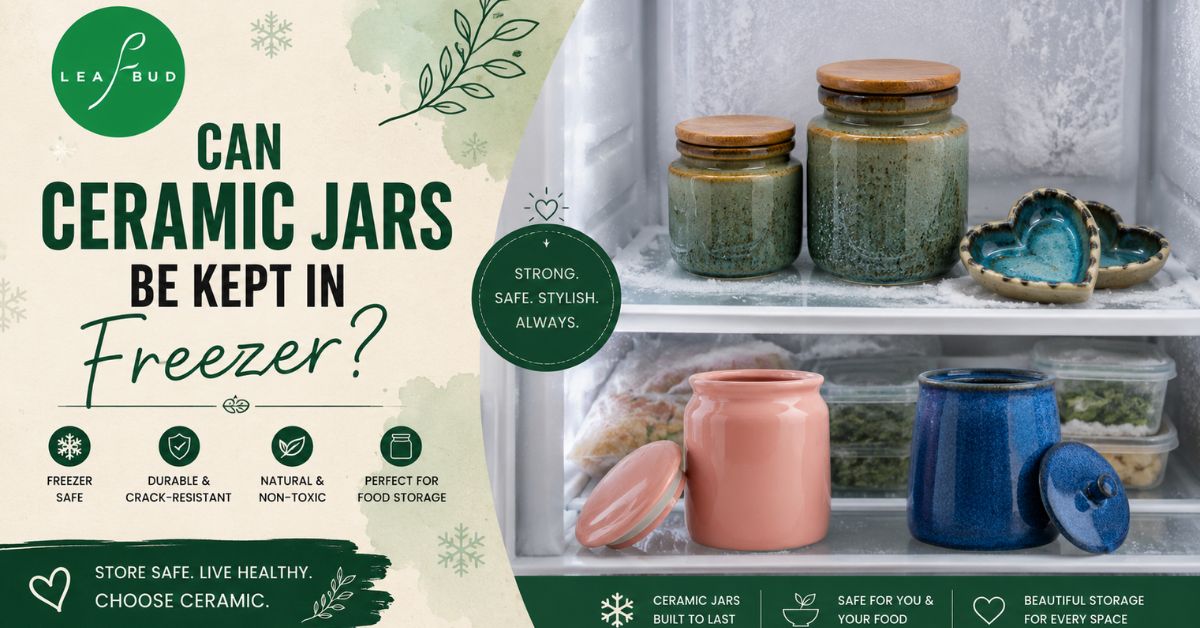
That’s a fair question. You have a ceramic jar sitting on your kitchen counter full of pickle, leftover dal, or something you want to preserve for a few days, and the freezer seems like the obvious next step. So, can you put ceramic jars in the freezer?
The short answer is sometimes yes, but not by default, and not without knowing what you’re dealing with.
So let’s break it down nice and clear so you know exactly what to do with your ceramic jars, when the freezer is safe and when it’s not.
The Central Issue: Thermal Shock
Before anything else, you need to understand one concept: heat shock.
Thermal shock is what happens when a material is subjected to a very rapid and extreme change of temperature. As the ceramic is quickly cooled from warm or room temperature to the deep cold of a freezer, the molecules in the clay body contract rapidly. Different parts of the jar cool differently. The stress that is uneven is what causes cracking, crazing (fine surface cracks), or, in serious cases, a complete break.
Thermal shock is the sudden change of temperature. It can chip, break, or crack a ceramic piece. A sudden change in temperature causes the molecules in a ceramic jar to rapidly expand or contract, and the speed of that movement creates intense stress that can crack or break the jar.
That doesn’t mean fragile ceramic jars. That means they require a certain type of handling around temperature transitions, and that’s something that most people miss without realising it.
So, Can Ceramic Jars Go in the Freezer?
The correct answer is.
A ceramic jar can be placed in the freezer only if the following conditions are met:
- The manufacturer states it is freezer safe
- The inside of the jar has a full glaze (no raw, porous clay).
- It is brought to room temperature before being put in the freezer.
- No hot or warm food goes directly from the stove or oven into the freezer in that jar.
- No chips or cracks on the jar.
Ceramic dishes that are labelled freezer-safe and are hardened and waterproof can be frozen. Not all ceramic dishes are fit for freezing and can shatter from thermal shock. If the dish is chipped or cracked, it can become weak and break when frozen.
The label “freezer-safe” on the bottom of the packaging of a ceramic jar is not just a label. It shows that the clay body was fired to a density, and the glaze was applied in such a way that it would withstand cold temperatures without soaking up moisture or cracking under stress.
If you don’t see the label, don’t assume it’s safe.”
What Happens If You Put a Regular Ceramic Jar in the Freezer?
A plain, untested ceramic jar placed in the freezer without preparation may crack.
Trends. Crazing is a network of fine cracks in the glaze surface. It doesn’t always cause a breakage immediately, but it does erode the structure over time and allows moisture into the clay body. Once crazing has begun, the jar should not be used to store food, as the porous areas can harbour bacteria.
Break outright. If the temperature change is drastic, such as moving a jar that has been sitting next to the stove right into a -18°C freezer, the stress can cause a visible crack right through the body of the jar.
Absorbs moisture. If the jar has unglazed or partially glazed areas, those work like a sponge in a cold, damp environment. That moisture expands and contracts with repeated freezing and thawing, gradually weakening the ceramic from the inside out.
Impact the food inside. If the jar cracks or crazes in the freezer, whatever is stored inside is at risk of contamination or freezer burn from the broken seal.
The Rules If You Do Use a Ceramic Jar in the Freezer
Should you confirm that your ceramic jar is freezer safe, proceed with these steps:
1. Chill food first. Do not put hot or warm food, straight from a ceramic jar, into the freezer. The pot should be cooled down to room temperature before going to the freezer. Hot dishes put in the freezer immediately can be subjected to a severe thermal shock. First, let the food sit on the kitchen counter to come to room temperature.
Step 2: Leave some headspace. When liquids freeze, they expand. Fill the jar only about three-fourths full. Even if the jar is freezer safe, if you fill it to the brim with liquid, it will crack when it freezes and the contents expand.
Step 3. Don’t make abrupt changes in either direction. Let the ceramic cool slowly to room temperature before moving it into very cold spaces, or it could experience reverse thermal shock and crack as it hits the deep cold. And vice versa, from frozen to hot, is just as dangerous. Never put a frozen ceramic jar directly into a hot oven or on a hot stove.
4. Check for chips before freezing. Even a ceramic jar, which is generally freezer safe, is not safe if it has any chips or cracks. If the dish has cracks or chips, it may also be weakened and may break when freezing. Run a finger along the rim and body of any ceramic before putting it in the freezer.
Step 5: Slowly thaw. Take the jar out of the freezer and place it in the fridge for a few hours, then bring it to room temperature. This gradual thaw is much safer than taking it directly from -18°C to room temperature or direct heat.
Ceramic vs. Other Freezer Storage Options
Here’s a quick comparison to help you decide what to use when.
Ceramic jars (only freezer safe): Great for holding cooked food, condiments, and dry goods that will be going into the freezer. Must be confirmed freezer-safe; handle with care. Not suitable for frequent freezer-to-oven use unless specially labelled as such.
Borosilicate glass: Typically more resistant to thermal shock than normal ceramic and better for freezer use if the glass is known to be freezer-safe. Still subject to breakage with careless handling.
Stainless steel or food-grade plastic containers. Most safe for freezer storage of liquids and cooked food, especially for frequent freeze/thaw cycles. No risk of thermal shock.
Silicone containers have the flexibility to pop food out after freezing, are freezer safe, and are flexible enough to accommodate expanding liquids. A good option if you regularly freeze things.
The fact is, ceramic jars aren’t the first thing you think of for freezer storage. They are functional within certain limits but are designed to work best at room temperature and in refrigerators, not in deep-freeze environments.
What Ceramic Jars Are Actually Best For
Ceramic jars are good at what they were made for, and the freezer is not their natural home.
Here they do their best:
Storage for everyday items under the counter. A well-glazed ceramic jar keeps spices, salt, sugar, tea, coffee, dry snacks, namkeen, and masala blends fresh at room temperature. Ceramic is a natural insulator that helps to keep the temperature inside the jar stable. Thus, the smell of coffee, the taste of spices, and the crispness of snacks remain for longer.
Storing pickles and achar. Ceramic jars have a glazed interior that is non-reactive, so they are perfect for acidic foods like pickles. Pickles kept in ceramic jars will last for months without going bad. That’s why the traditional Indian bharani jar has always been ceramic; it was never meant for the freezer. It was intended for the dark, cool corner of the kitchen where the temperature stays consistent.
Short-term fridge storage. In general, then, it’s fine to move a ceramic jar from room temperature into the fridge (not the freezer); the change is slow and moderate (say, from around 25°C to 4°C). Thermal shock is not much of a problem.
Open shelf display function. A ceramic jar on a kitchen shelf is more than a container. It keeps ingredients organised, looks nice, and, unlike a plastic box, doesn’t leach chemicals or absorb smells from surrounding things.
Leafbud’s Ceramic Jars: What They Are Made For
Leafbud works with independent Indian artisans to create handcrafted ceramic jars from natural clay, fired and glazed for everyday use in kitchens. The Magikal Pickle Jar range is available in red, blue, brown, and pink and is designed to store pickles and condiments. The Sugarlandia Pot is meant for everyday at-counter access to tea, coffee, sugar, and the like.
These are the pantry, shelf, fridge, and kitchen jars for the counter. They are not sold as freezer safe, and Leafbud does not recommend putting them in the freezer unless asking the team if a particular piece is up for that purpose.
If you wish to use any of the Leafbud ceramic jars for cold storage outside of the fridge, please email the team to check that it is suitable for use before use.
For the full selection of ceramic jars from Leafbud, please visit the website.

Quick Reference: Ceramic Jars and Cold Storage
Take this as a quick guide before you make any storage decisions:
Room-temperature storage (spices, tea, sugar, namkeen) → Yes, best is ceramic jars
Refrigerator storage (pickles, cooked food, leftovers) – Generally okay; cool food to room temperature first
Freezer storage. Only if the jar is confirmed freezer-safe by the manufacturer; otherwise, don’t
Freezer to oven directly → NEVER unless the jar is specifically marked freezer-to-oven safe
Jar with a chip or crack in the freezer → Never, even if previously freezer safe
FAQs: Ceramic Jars and the Freezer
Q1. Can I store pickles in a ceramic jar in the freezer?
You can put the pickle in a ceramic jar in the fridge, no problem. Use the freezer only if the jar is freezer-safe, as indicated by the manufacturer. Most traditional ceramic pickle jars (ceramic pickle jars made by hand) are not labelled as freezer-safe and can crack in deep freeze conditions. Better yet, store achar at room temperature in a cool, dark place, or in the refrigerator, the latter of which ceramic does best in.
Q2. My ceramic jar has no markings. Is it freezer-safe?
Don’t assume a ceramic jar or its packaging can go in the freezer unless there is a freezer-safe mark on the base. If no label is present, the manufacturer has not tested or guaranteed it is effective for that use. See the brand’s site or ask the seller directly. In doubt, store unmarked artisan pieces at room temperature or in the fridge.
Q3. What is thermal shock, and why does it matter for ceramic jars?
Thermal shock is the stress created in a material due to a rapid temperature change. In ceramics, it causes the clay molecules to expand or contract unevenly, creating internal stress that can crack or chip the jar. Another common cause is taking a ceramic jar from a warm kitchen counter and putting it in the freezer at –18°C. Slow temperature changes are always the solution. Cool the food first, then store it in the refrigerator before freezing.
Q4. Is it safe to use a ceramic jar in the fridge (not the freezer)?
Yes, in the majority of cases. The transition from about 25°C (room temperature) to 4°C (fridge temperature) for moving ceramic is a gentle one unlikely to cause thermal shock. Allow the food to cool to room temperature before placing it in the fridge. Don’t take a jar that has just been near a heat source and put it straight into cold storage. Ceramic jars are a good option for short to medium-term storage of pickles, cooked food, and condiments in the fridge.
Q5. Can I move a ceramic jar from the fridge straight to the microwave?
It depends on the jar. Not all ceramics are microwave safe; look for a microwave-safe symbol on the base. Even ceramics that are microwave safe should not be transferred from the freezer to the microwave, because the shock of the temperature is too great. If the piece is confirmed microwave safe, generally, it is fine to gently reheat the piece from the fridge in the microwave. Do not microwave on high with any ceramic jar.