Chat with us
FREE Leafbud Umbrella on Prepaid Orders Above INR 4,500/-
FREE Leafbud Umbrella on Prepaid Orders Above INR 4,500/-
FREE Leafbud Umbrella on Prepaid Orders Above INR 4,500/-
FREE Leafbud Umbrella on Prepaid Orders Above INR 4,500/-
FREE Leafbud Umbrella on Prepaid Orders Above INR 4,500/-
FREE Leafbud Umbrella on Prepaid Orders Above INR 4,500/-
FREE Leafbud Umbrella on Prepaid Orders Above INR 4,500/-
FREE Leafbud Umbrella on Prepaid Orders Above INR 4,500/-



What Are the Different Types of Ceramic Bowls?

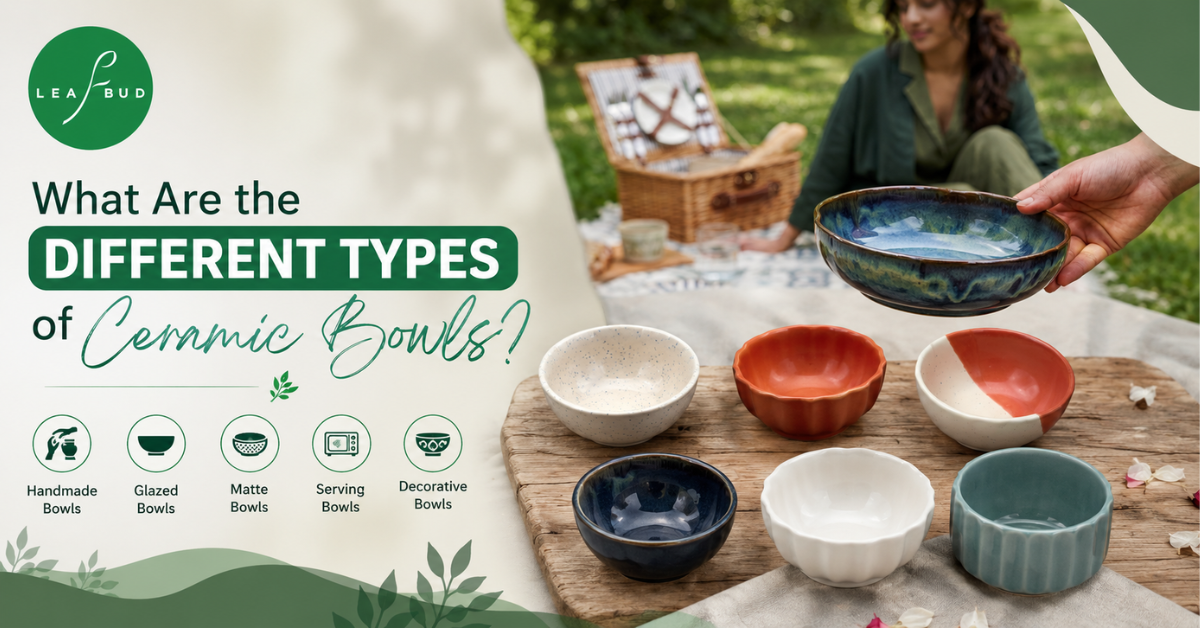
Walk into any home store or browse an online serveware catalogue, and you’ll notice something: not all ceramic bowls are created equal. Some look heavy and rustic, others light and glassy smooth. Some of them keep soup all evening without cooling; others are built for a quick bowl of curd at breakfast. So what are the different types of ceramic bowls, and how do you pick the right one for your kitchen? Let’s unpack that.
Ceramic Bowls by Material: What’s the Clay Actually Made Of?
The biggest difference between bowls, before you get to shape or size, comes from the clay itself and how hot it was fired. Potters have always grouped ceramics in three broad families.
Earthenware Bowls
Earthenware is the oldest kind of pottery, fired at the lowest temperatures, usually between 1,745 and 2,012 degrees Fahrenheit. This lower heat keeps the clay body porous, so earthenware bowls need a glaze to hold liquid without seeping. Fired earthenware is coloured with warm reds, oranges, and browns and has a soft, handmade look that many people love for everyday dining. Terracotta bowls are also included in this category and are much prized in Indian kitchens for keeping the curd thick and cool.
Stoneware Bowls
Stoneware in the middle. It is fired at higher temperatures, usually between 2,000 degrees F and 2,400 degrees F, to make the clay dense and rock hard. This is the workhorse of most kitchens. Stoneware bowls are fired to make them waterproof, even without glaze, and they are less likely to chip than earthenware. If you have a soup bowl at home that is chunky and slightly speckled, chances are it is stoneware.
Porcelain Bowls
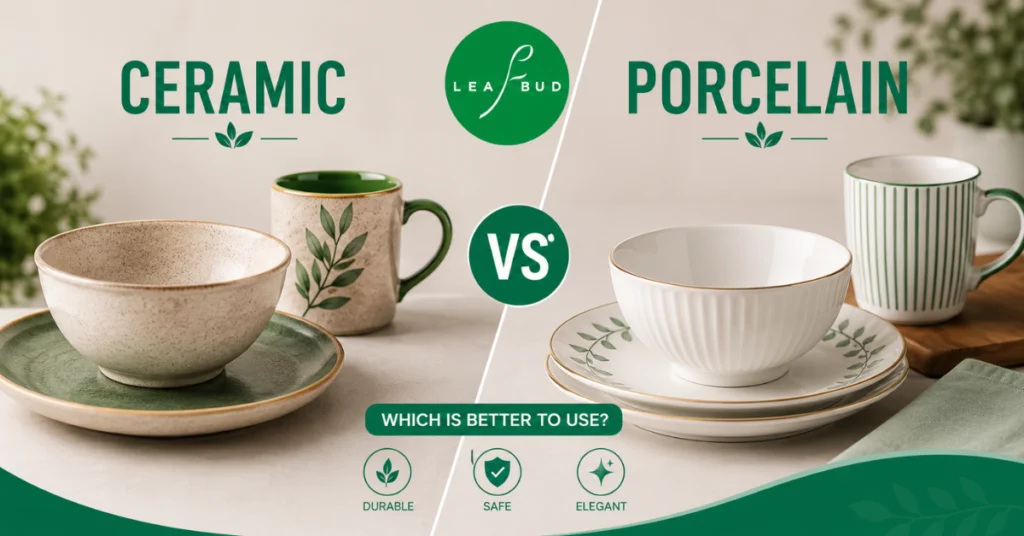
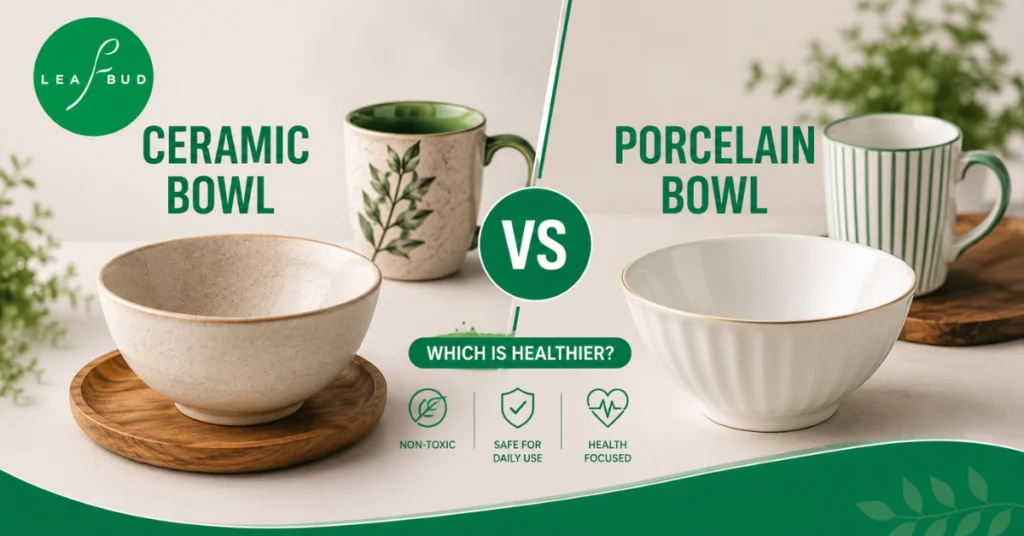
The hardest and best choice is porcelain, fired at more than 2,300°F with kaolin clay. The result is a smooth, often translucent surface that feels elegant on a dining table. Porcelain bowls are more resistant to chipping than earthenware but can crack when the temperature changes rapidly, so they are better for serving than for use on the stovetop. This usually includes fine china dinnerware.
Ceramic Bowls by Everyday Use
The second way of sorting ceramic bowls is what you actually use them for. Putting material aside. This is where things get very practical for your kitchen shelf.
- Serving bowls: Wide and shallow, designed to put dishes in the middle of the table for a meal or gathering.
- Soup bowls: These are deeper with a rounded bottom and are used to hold broth or dal without spilling and to keep warm longer.
- Curd bowls are small, porous bowls, often made of terracotta or unglazed ceramic, used to prevent the curd from becoming too sour too quickly.
- Portion bowls: Small bowls for individual servings, condiments, or side dishes such as pickles and chutney.
- Ramen bowls: Deep, tall bowls that can hold your noodles, broth, and toppings without spilling over.
- Wok bowls. Round and deep-bellied, wok-shaped bowls are ideal for stir-fry dishes and rice bowls.
- Snack bowls: Small, often decorative bowls for nuts, chips, or a quick evening snack.
- Salad and Pasta Bowls: Wide-mouthed and roomy, so you can toss your ingredients without spilling over the sides.
- Mixing bowls: They are bigger and more robust and are meant for whisking, kneading, or making batter in the kitchen.
Knowing which bowl works for what job saves you from serving hot soup in a shallow snack bowl or trying to toss a salad in something made for curd.
Glazed vs Unglazed Ceramic Bowls
There is also a way to look at bowls based on finish, and it changes the way they behave in everyday use.
- Before the second firing, glazed bowls are coated with a thin layer of liquid glass. This results in a non-porous surface that is easy to clean and available in a wide range of colours and finishes from glossy to matt.
- Unglazed bowls let the surface of the raw clay show. They breathe more, which is why unglazed terracotta and ceramic are traditionally used for curd and fermented foods, but they need more careful cleaning, as the surface can absorb odours and oils over time.
There is no one option that is best in all cases. It depends on what you serve and how much maintenance you want.
Handcrafted vs Machine-Made Ceramic Bowls
Another difference worth knowing is how the bowl was actually shaped. Each of the bowls in a set of machine-made bowls is identical because the bowls are pressed out of a mould. Each bowl is made by hand, either on a potter’s wheel or shaped by hand, so there are slight variations in the glaze, rim, and curve of each piece. And that little unevenness is often the point. It’s part of a design philosophy known as wabi-sabi, which identifies beauty in imperfection and celebrates the uniqueness of a handmade object.
That’s the thinking behind the bowl categories on Leafbud, from the curd bowls to the soup bowls to the ramen bowls to the wok bowls to the serving bowls. Each piece is handcrafted by artisans, so no two bowls in a batch look exactly alike, and the finish holds the texture of the hand that made it rather than a mould.
Ceramic Bowls in the Indian Kitchen
India has a long-standing relationship with clay tableware, and this is evident in the shapes and uses of bowls all over the country. Curd is almost always served in earthenware or terracotta for a reason; the slight porosity keeps the setting curd cool and prevents it from turning sour too quickly, something that steel or plastic just can’t achieve. Dal and sambar need deeper bowls that hold heat. A thali meal is typically served in a combination of small portion bowls for pickle, chutney, and sabzi arranged around a central plate.
The same clay traditions have evolved, with dining habits shifting towards global cuisines. Once a household would have one or two types of bowls, but now they often have ramen bowls for noodle nights, wok bowls for stir-fried rice and pasta bowls for weekend cooking experiments, along with the everyday curd and serving bowls. The material has hardly changed in centuries. The change is in the sorts of shapes people expect to find in one kitchen shelf.
How Bowl Shape Affects the Way Food Tastes and Feels
A bowl is often just thought of as a container, but its shape influences how food acts. Serving bowls are made wide because a shallow, wide bowl makes the soup or curry cool off more quickly, and the aroma spreads more openly. A deep, narrow bowl, like a ramen or wok bowl, holds heat longer and keeps broth from splashing as you eat. Curd bowls are intentionally small and shallow because a thin layer sets and cools more evenly than a thick one. All of this is not by accident. Bowls have been perfected in shape through generations of daily use, long before anyone ever wrote them down as a design principle.
A quick way to match the right type to your needs is the following:
- Daily meals: Stick with stoneware. It is hard enough for everyday use and takes the dishwasher well.
- Curd or fermented foods: Use terracotta or unglazed ceramic for better aeration.
- Hosting or gifting: A porcelain or hand-glazed stoneware bowl is elegant on a table and a thoughtful gift.
- Noodles or broths: Use a tall ramen-style bowl to avoid spills when you stir.
- Snacks and condiments: Small portions or snack bowls are best, keeping quantities small and presentation neat.
If you’re building a complete collection, combining a few varieties (for example, a wok bowl for stir-fries, a couple of curd bowls, and a stack of serving bowls) will usually meet most of your kitchen needs without taking up too much space on your shelves.
Caring for Ceramic Bowls So They Last
A well-fired ceramic bowl will last you years if you treat it right.
- Do not subject the bowl to rapid changes in temperature, such as taking a bowl from the freezer and putting it directly into a hot oven.
- Wash delicate glazed or hand-painted pieces by hand to preserve the finish.
- Use a soft cloth or paper to separate pieces when stacking bowls so as not to scratch.
- Glazed and unglazed pieces finish differently, so be sure to check if a bowl is labelled microwave-safe or dishwasher-safe before using it as such.
Wrapping Up
In the different kinds of ceramic bowls, there are three factors that overlap: the type of clay (earthenware, stoneware, or porcelain); the shape built for a specific job (soup, curd, ramen, wok, or serving); and the finish (glazed or unglazed, handcrafted or machine-made). Knowing the purpose of each type makes choosing bowls for your kitchen so much less confusing and so much more intentional.
FAQs
What is the most durable type of ceramic bowl?
Stoneware is generally the most durable for everyday use. Stoneware is fired at a high temperature and is more chip-resistant than earthenware. It does not need a glaze to make it waterproof, although most stoneware bowls are glazed for a smoother finish.
Which ceramic bowl is best for serving curd?
Best for curd are terracotta or unglazed ceramic bowls. Their slightly porous surface helps to maintain a steady temperature and allows the curd to set naturally without souring too quickly.
Are handcrafted ceramic bowls better than machine-made ones?
Which is better is a matter of opinion, but handmade bowls have the advantage that the glaze and shape will vary naturally, giving each bowl its own character. Some people prefer the uniformity of machine-made bowls for matching sets.
Can ceramic bowls go in the microwave and dishwasher?
Most glazed stoneware and porcelain bowls are also microwave and dishwasher-safe. Always check product details first. Some hand-painted or finely glazed pieces may need to be washed by hand to protect the finish.
What’s the difference between a serving bowl and a mixing bowl?
Serving bowls are shallow and designed for serving food at the table. Mixing bowls are larger and more sturdy, built to whisk, knead, or prepare batter before the food ever makes it to the table.
Shop Handcrafted Ceramic Bowls