FREE Leafbud Umbrella on Prepaid Orders Above INR 4,500/-
FREE Leafbud Umbrella on Prepaid Orders Above INR 4,500/-
FREE Leafbud Umbrella on Prepaid Orders Above INR 4,500/-
FREE Leafbud Umbrella on Prepaid Orders Above INR 4,500/-
FREE Leafbud Umbrella on Prepaid Orders Above INR 4,500/-
FREE Leafbud Umbrella on Prepaid Orders Above INR 4,500/-
FREE Leafbud Umbrella on Prepaid Orders Above INR 4,500/-
FREE Leafbud Umbrella on Prepaid Orders Above INR 4,500/-



What Is Ramen? Ramen vs Noodles (and Maggi), Explained

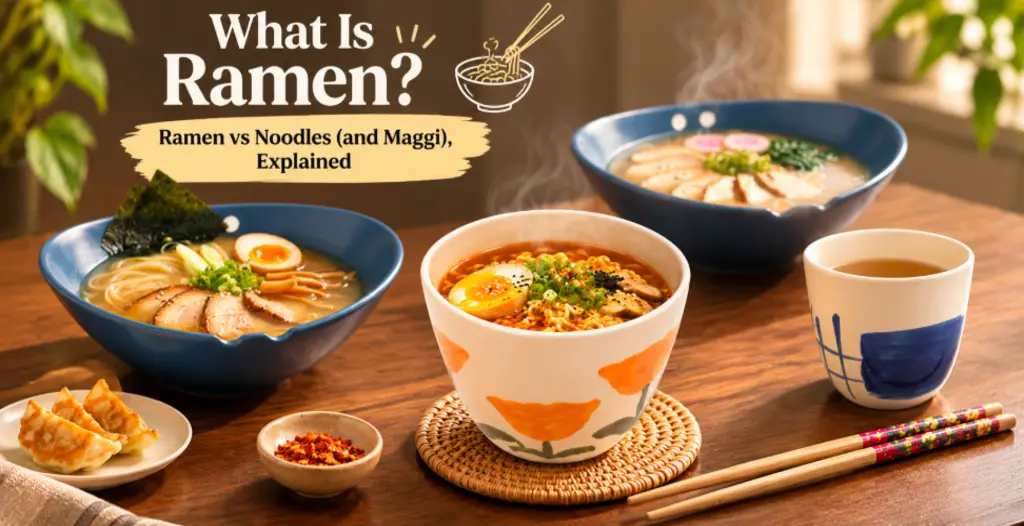
Ramen has travelled a long way to reach Indian kitchens. It shows up in anime, in K-dramas, in the Korean noodle packets that now sit beside Maggi on supermarket shelves, and on the menus of ramen bars in most big cities. Yet ask five people what ramen actually is and you will get five answers, from “Japanese Maggi” to “any noodle soup”.
Here is the short version, followed by everything that makes ramen different from the noodles you already know.
What is ramen? The short answer
Ramen is a Japanese noodle soup. A bowl of ramen has four parts: springy wheat noodles made with an alkaline water called kansui, a slow-cooked broth, a concentrated seasoning called tare that gives the bowl its main flavour, and toppings such as sliced pork, a soft-boiled egg, spring onions, nori and bamboo shoots.
- All ramen is noodles, but not all noodles are ramen. What makes ramen noodles different is the kansui, which gives them their bounce and pale yellow colour.
- Maggi is not ramen in the Japanese sense. It is an instant noodle: pre-cooked, dried noodles with a seasoning sachet. Instant noodles were inspired by ramen, which is why many packets carry the word, but a restaurant bowl of ramen is a different dish.
\Where ramen comes from
Ramen began as a Chinese wheat noodle soup. Chinese cooks brought it to Japanese port cities such as Yokohama in the late 1800s, and the dish was first known in Japan as shina soba, or “Chinese noodles”. Rairaiken, which opened in Tokyo’s Asakusa district in 1910, is often credited as one of the first shops to make it popular.
Over the next few decades, especially after the Second World War, Japanese cooks made ramen their own. Every region developed its own broth, noodle and topping style, and ramen shops became one of the most loved parts of Japanese food culture.
Then, in 1958, Momofuku Ando launched the first instant noodles in Japan. His idea, pre-cooked noodles that only needed hot water, spread across the world, and it is the reason most of us met “ramen” as a packet long before we met it in a bowl.
What makes ramen,
1. The noodles
Ramen noodles are made from wheat flour, water, salt and kansui, an alkaline solution of mineral salts. Kansui changes how the dough behaves: the noodles turn firm, springy and slightly yellow, and they hold their texture in hot broth instead of going soft. They come in many thicknesses, from thin and straight to thick and wavy.
2. The broth
The broth is simmered for hours from chicken, pork bones, seafood, vegetables, or a mix. Some are light and clear; others, like tonkotsu, are rich and cloudy. Vegetarian ramen uses broths made from vegetables, mushrooms and kombu (seaweed).
3. The tare
Tare is the concentrated seasoning that goes into the bottom of the bowl before the broth is poured in. It decides the bowl’s main flavour, and it is what most ramen styles are named after.
4. The toppings
Classic toppings include chashu (braised pork), a soft-boiled marinated egg (ajitama), spring onions, nori, menma (fermented bamboo shoots) and fish cake. At home, anything goes: corn, mushrooms, bok choy, tofu, paneer, chilli oil.
Why the bowl matters
Ramen needs more room than most Indian bowls give it. A proper ramen bowl is deep enough for a generous pour of broth and wide enough at the top to hold the noodles and arrange the toppings, with space to lift the noodles without splashing. A wide mouth also lets the aroma reach you, which is half the pleasure of a good bowl. A regular katori or cereal bowl is simply too small.
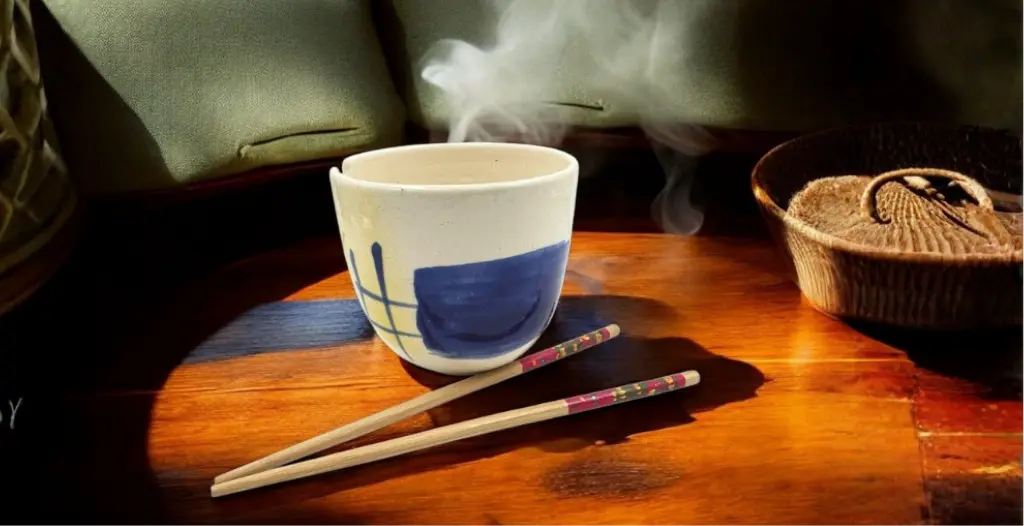
Designed exclusively by Deeksha Gupta for Leafbud, it completes its story with a pair of artisanal chopsticks
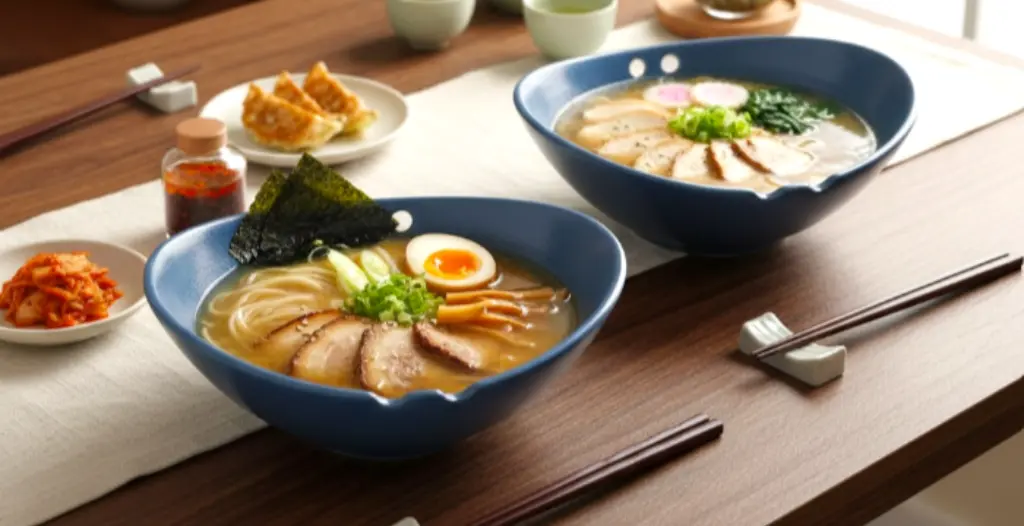
A pair of 8-inch bowls in a deep blue natural glaze, designed by Leafbud for ramen, noodle bowls, curries and soups. A good pick if ramen night is a meal for two.
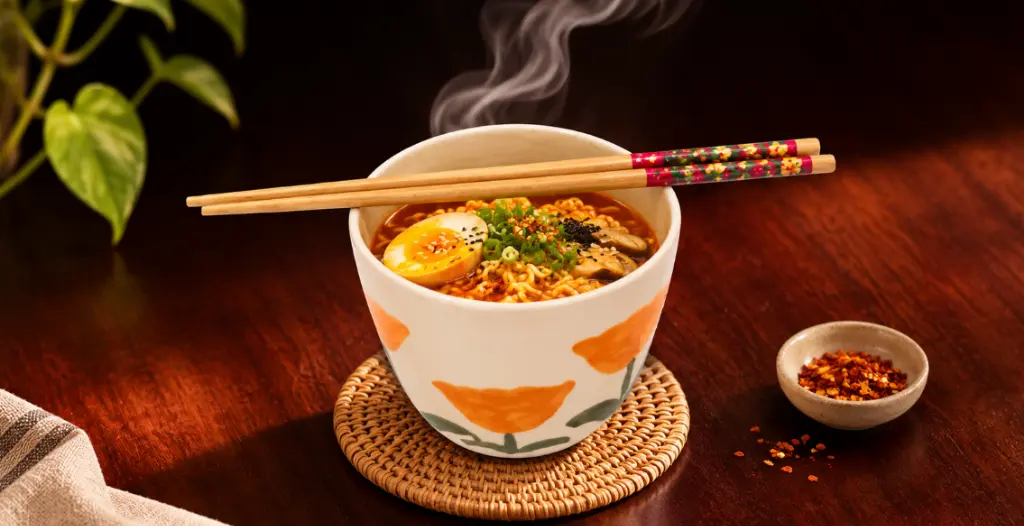
Designed by artist Deeksha Gupta in orange and white, in high-fire stoneware, with the depth and width to hold broth, noodles and toppings without crowding them. It comes with two decorative chopsticks, whose designs may vary from the photos.
Every piece is handmade, so glaze and form vary slightly. Prices are MRP at the time of writing. See all ramen bowls.
The main types of ramen
Type | What flavours it | What it tastes like |
Shoyu | Soy sauce tare | Savoury and balanced, usually with a clear brown broth. The most common style in Tokyo. |
Shio | Salt tare | The lightest and clearest. Lets the broth’s flavour come through. |
Miso | Fermented soybean paste | Rich, nutty and slightly sweet. Strongly linked to Sapporo in Hokkaido. |
Tonkotsu | Pork bone broth, boiled until milky | Creamy, rich and full-bodied. Linked to Fukuoka in southern Japan. |
Two common variations: tsukemen, where cold noodles are dipped into a thick, concentrated broth served on the side, and mazesoba, a brothless ramen tossed with sauce.
Ramen vs noodles: what’s the difference?
“Noodles” is the whole family. Ramen is one member of it.
Ramen | Noodles in general | |
Made from | Wheat flour with kansui (alkaline water) | Wheat, rice, buckwheat, mung bean, egg and more |
Texture | Firm, springy, holds up in hot broth | Ranges from soft (rice noodles) to chewy (udon) |
Colour | Pale yellow, from the kansui | Depends on the flour: white, brown, translucent |
How it’s served | Almost always in broth, as a complete meal | Soups, stir-fries, cold salads, side dishes |
Examples | Shoyu, miso, tonkotsu ramen | Hakka noodles, udon, soba, rice noodles, spaghetti |
So the Hakka noodles you get at your local Indo-Chinese place are noodles, but they are not ramen: they are stir-fried, and they are not made with kansui. Udon and soba are Japanese noodles too, but they are separate dishes, with different doughs and different broths.
Is Maggi ramen? Ramen vs Maggi vs Korean ramyeon
This is the question most Indian readers are really asking.
Japanese ramen | Korean ramyeon (instant) | Maggi | |
What it is | A noodle soup made fresh, with a long-simmered broth | Instant noodles, usually spicy, often eaten with plenty of soup | Instant noodles with a masala seasoning sachet (“tastemaker”) |
Noodles | Fresh alkaline wheat noodles | Pre-cooked, dried wheat noodles | Pre-cooked, dried wheat noodles |
Broth | Hours of simmering, seasoned with tare | Made from a powder or paste in the packet | Little or no broth; cooked down to a thick masala |
Time | Hours to make, minutes to eat | A few minutes | A few minutes |
Best known as | A restaurant meal | The noodles you see in K-dramas | India’s favourite comfort snack |
Is Maggi ramen? Not in the Japanese sense. Maggi belongs to the instant noodle family that grew out of ramen, but it is its own thing, made for the Indian taste, with masala rather than a soup broth.
Is Korean ramen the same as Japanese ramen? No. In Korea, ramyeon almost always means instant noodles, usually fiery and eaten with a generous amount of soup. Japanese ramen usually means a fresh bowl made at a ramen shop.
None of this makes one better than the others. A late-night Maggi, a bowl of spicy ramyeon and a slow-cooked shoyu ramen each have their place.
How to make instant noodles feel more like ramen
You don’t need to simmer a broth for 12 hours to get closer to the real thing:
- Cook the noodles separately and add them to the hot soup just before serving, so they stay springy.
- Use more liquid than the packet suggests, and add a splash of soy sauce and a few drops of sesame oil.
- Add a soft-boiled egg. Boil it for about 6 to 7 minutes, cool it in cold water, then peel and halve it.
- Top it properly: spring onions, a sheet of nori, sweetcorn, sautéed mushrooms or a spoon of chilli oil.
- Serve it in a deep, wide bowl, so there is room for the noodles, the soup and the toppings without spilling.
Once it’s in the bowl, here’s how to eat ramen the proper way, including why slurping is completely fine.
Frequently asked questions
What is ramen in simple words?
Ramen is a Japanese noodle soup made with springy wheat noodles, a rich broth, a seasoning base called tare, and toppings such as egg, pork, spring onions and nori.
What is the difference between ramen and noodles?
Noodles are the whole family, made from wheat, rice, buckwheat and more. Ramen is a specific Japanese dish whose wheat noodles are made with kansui, an alkaline water that makes them firm, springy and slightly yellow, and which is almost always served in broth.
Is Maggi a type of ramen?
Not in the Japanese sense. Maggi is an instant noodle, pre-cooked and dried, with a masala seasoning. Instant noodles were inspired by ramen, but a bowl of Japanese ramen is made fresh with a slow-cooked broth.
Is ramen Japanese or Korean?
Ramen is a Japanese dish that grew out of Chinese wheat noodle soups. Korean ramyeon is a Korean take on instant noodles and usually refers to packet noodles.
What are ramen noodles made of?
Wheat flour, water, salt and kansui, an alkaline solution that gives ramen noodles their bounce and pale yellow colour.
Is ramen vegetarian?
Traditional ramen broths often use pork, chicken or seafood, but vegetarian ramen made with vegetable, mushroom and kombu broth is widely available and easy to make at home. Check the ingredients on any instant packet.
What are the main types of ramen?
The four classic types are shoyu (soy sauce), shio (salt), miso (soybean paste) and tonkotsu (pork bone broth).
Related reading: How to Eat Ramen: Chopsticks, the Spoon and Why Slurping Is Fine | Ceramic Serving Bowls for Every Cuisine