FREE Leafbud Umbrella on Prepaid Orders Above INR 4,500/-
FREE Leafbud Umbrella on Prepaid Orders Above INR 4,500/-
FREE Leafbud Umbrella on Prepaid Orders Above INR 4,500/-
FREE Leafbud Umbrella on Prepaid Orders Above INR 4,500/-
FREE Leafbud Umbrella on Prepaid Orders Above INR 4,500/-
FREE Leafbud Umbrella on Prepaid Orders Above INR 4,500/-
FREE Leafbud Umbrella on Prepaid Orders Above INR 4,500/-
FREE Leafbud Umbrella on Prepaid Orders Above INR 4,500/-



Why Pickle is Stored in Ceramic Jars?

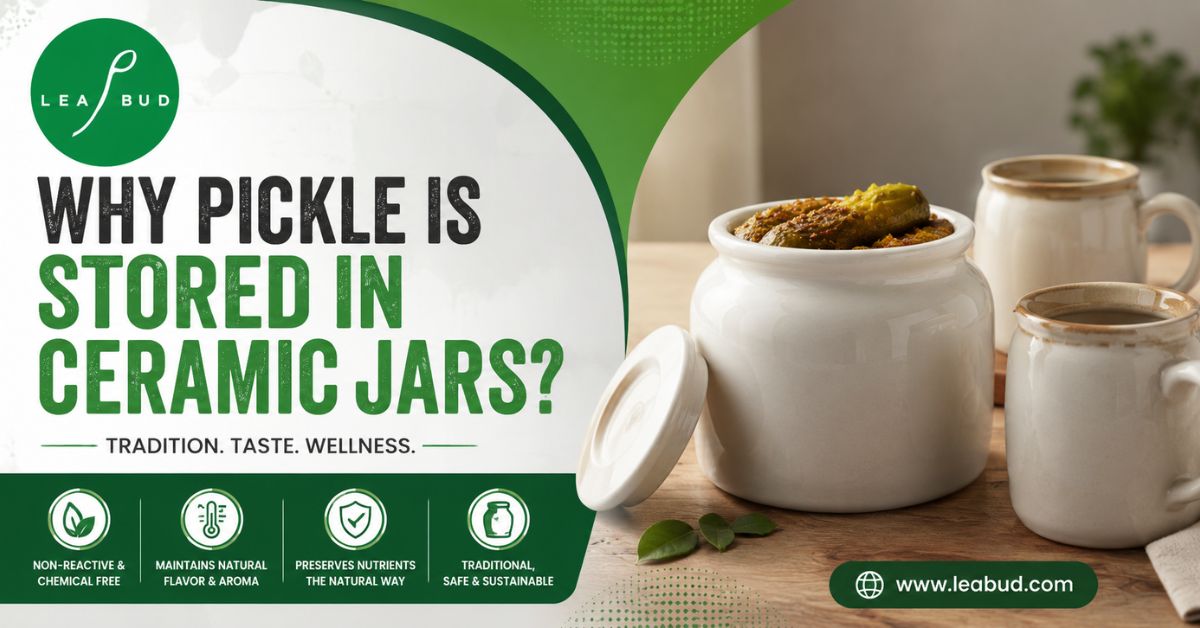
Walk into any Indian home, and you will probably find a ceramic jar in the kitchen or on a sun-kissed terrace. Inside it, a batch of mango achar, lemon pickle, or mixed vegetable pickle silently ages in spiced oil. It is not a coincidence; it is not just a habit. There are real and practical reasons for putting pickles in ceramic jars, reasons that have existed for thousands of years and still hold true today.
Let’s break it down on the traditional side and the scientific side.
A Tradition That Goes Back Over 4,000 Years
Pickling is one of the oldest methods in the world to preserve food. The practice goes back to around 2400 BC in ancient Mesopotamia, when people stored vegetables in brine to prepare for long journeys and lean seasons. Pickling in India probably goes back over 4,000 years to the Indus Valley Civilisation, when archaeological evidence of early preservation with salt and oil has been found.
The traditional pickle jar in India has different names across the country: martaban in the north, jaadi in Andhra Pradesh and Tamil Nadu, and bharni in Maharashtra. These jars were constructed of earthenware or ceramic well before plastic or glass became common household materials. And they worked. Indian families for generations stored large batches of achar in ceramic jars, put them under the sun to mature, and shared the results with family and neighbours as an act of love and community.
Indian families used to make large amounts of pickles and keep them in ceramic jars called martabans to share with the extended family and neighbours. Indeed, the making of pickles was an occasion in itself, an occasion for people to come together and mix spices, sun-dry ingredients, and bottle the results with care.
This was more than a cultural sentiment. Real results, real observations. Clay jars were better than most of the other options at the time. And here’s why:
The Science: Why Ceramic Works So Well for Pickles
Ceramic Does Not React with Pickle
Ceramic does not react with pickles.
Pickles are sour. Indian pickles are oil-based and contain salt, chilli, and usually vinegar or natural fruit acids. They can react with the metal of the container, change the taste, and even release harmful compounds into the food.
Unlike most modern plastic jars, ceramics do not react to the contents of the pickle. This non-reactive quality means the pickle is exactly as it should be; the ceramic adds nothing to and takes nothing from the flavour. This is hugely important for a product that is supposed to age and develop character over weeks and months.
The Shape of the Jar Controls Air Exposure
‘Bārni’, traditional ceramic pickle jars with narrow necks. The neck is narrow, so there is less air coming in when the jar is opened. Less air going into the jar means less moisture going in. Moisture helps in the growth of molds in stored food items, and less exposure to moisture means longer preservation of the pickle.
This is not an accidental design. Pickle-makers over generations knew that wide-mouthed jars were a recipe for spoilage. The narrow neck was standardised because it worked.
Ceramic Acts as a Natural Insulator
One of the biggest enemies of food preservation is temperature changes. A jar that heats up quickly in the afternoon sun and cools down quickly at night creates conditions where fermentation can be inconsistent, and bacteria can grow.
“Thermally insulating” is a property of ceramics. Ceramic maintains the temperature inside the jar. This helps to keep the flavour and freshness of the ingredients for longer. The thick walls of a ceramic jar slow down the transfer of heat both ways, keeping the inside cooler during the day and warmer at night. And that’s exactly what a maturing pickle needs – a stable environment.
Ceramic Does Not Absorb Odours or Flavours
A glazed ceramic jar will not acquire any smell or taste from its former contents. Ceramic is non-porous, and glazed ceramic won’t absorb smells or tastes, so your ingredients will remain fresh and untainted. Unlike plastic. It’s a good match for pungent pickles with bold spice profiles. Don’t worry if your new batch of garlic pickle tastes a little like the one in the jar before.
Ceramic Supports Controlled Fermentation
Fermented pickles, the kind that use naturally occurring bacteria instead of vinegar, require a certain environment to grow properly. The ceramic jars aid in controlled fermentation, which lets the flavour develop over time. The stable temperature and non-reactive surface create the perfect conditions for the lactic acid bacteria to get to work, slowly and steadily.
It’s not like a metal tin, where the acid can react with the surface, or a thin plastic container, where temperature swings too quickly for steady fermentation.
The Jaadi: A Piece of Indian Kitchen History
Of special mention is the South Indian jaadi. In the good old days, all pickles, curds, and ghee were stored in earthen pots. During British rule, chemicals were imported in glazed ceramic containers. After use, the empty porcelain jars were sold to the public. As they were neutral, they were considered to be the ideal containers to be used in place of earthen pots.
In fact, the brown-and-white colour combination of the jaadi that became standard in South India was a British convention used to mark a container that held chemicals. When Indian households adopted these jars for food storage, the design remained, and so did the colour. The jaadi became a symbol of South Indian pickle-making culture, instantly recognisable in any kitchen or on any terrace where pickle jars lined up, soaking up the afternoon sun.
Sun-Curing and the Ceramic Jar
A very characteristic step in Indian pickle-making is to put the jar in the direct sun for days or weeks after packing. The sun-curing process serves several functions. The heat kills off any bacteria that might spoil the fruit. The heat helps the oil and spices to penetrate the fruit or vegetable completely.
Ceramic is good at this process. The thick walls help to evenly distribute heat and prevent hot spots, which can cause uneven curing. Big ceramic jars of fresh pickles sitting in the sun on terraces bring back memories of carefree holidays, a line from a food writer that captures exactly how deeply this image is embedded in Indian memory.
In this process, the jar is not just a vessel. It actively contributes to developing the character of Pickle.
What Happens If You Store Pickles in Other Containers?
Now, let us look at the alternatives to ceramic.
Plastic containers. Plastic can absorb the strong odours and colours of the pickle spices. The oil and acid in pickles can eat away at some plastics over time, which means chemicals could leach into the food. Thin plastic also doesn’t offer much temperature stability.
Metal containers: Acidic pickle brine can react with many metal containers, especially if they are untreated or uncoated. This can affect the taste of the pickle and can also contaminate the food with metallic compounds in some cases. In traditional Indian cooking, untreated metal containers have never been used to store acidic foods such as tamarind and pickle.
Glass jars: Glass is a good alternative to ceramic for pickle storage. It is also non-porous and does not absorb odours. The main practical difference is that glass is less thermally insulating than ceramic and less forgiving when dropped. Glass jars became common in Indian kitchens only in the 20th century, by which time ceramic had already taken hold.
Choosing the Right Ceramic Jar for Pickle Storage Today
Not every ceramic jar you find on the market is suitable for pickling. Here’s a quick checklist to help you decide:
Food-safe glaze: The inside of the jar should be coated with a food-safe, lead-free finish. The pickle will seep into an unglazed interior and rot over time.
Important: air control. Tight-fitting lid. A tight-fitting lid will reduce the exposure to oxygen and moisture.
No cracks or chips in the glaze: Glaze damage can cause bacteria to grow and possible contamination.
Proper size: If you use a jar too large for the amount of pickle you are making, you will have too much air space in the jar, which reduces the shelf life.
Narrow neck or wide mouth with a good sealing lid: Both designs are fine, but the seal is a must.
That’s exactly the kind of use the handcrafted ceramic pickle jars at Leafbud are made for. The jars mix artisan craftsmanship with a practical design for Indian kitchens, where a good pickle jar is a staple, not a decoration. Collection of Ceramic Jars Pickle Jars, Condiment Jars, Storage Jars. All jars are manufactured by skilled artisans.
Caring for Your Ceramic Pickle Jar
With some simple care, a ceramic pickle jar can last for years.
Prior to first use, wash the jar thoroughly and dry completely. Never put a pickle into a damp jar. Moisture is the one thing you are trying to keep out. After each batch of pickles, rinse the jar with warm water and mild soap. Do not use harsh abrasives that could scratch the glaze.
Check the glaze regularly. If you notice chips or crazing (a network of fine cracks) or a grey residue on the glaze after washing, retire the jar from food storage. Broken glaze means the barrier between the clay and your food is deteriorating.
Store the jar away from strong heat sources, not including intentional sun-curing. Repeated temperature extremes can put a strain on the ceramic and accelerate wear.

Ceramic Jars and the Art of Making Achar at Home
Homemade achar is one of those kitchen traditions that rewards patience. The right jar is more important than most people think. It keeps the environment of the pickle for weeks or months. It is the test of whether the flavours of the spice are fully blooming, whether the oil remains clear, and whether the texture of the fruit or vegetable is intact.
Keeping pickles in ceramic jars is not just nostalgia. This is because ceramic, when properly glazed and well-made, provides the most stable, neutral, and controlled environment for the pickle to develop exactly as it should. No plastic container can fully replicate this, and glass can only partially replicate this.
FAQs
Q1. Why is pickle traditionally stored in ceramic jars rather than plastic ones?
Plastic can absorb smells and degrade over time with exposure to oil and acid. Ceramic does not react with the pickle’s acidic contents. Ceramic also offers better temperature stability, which means the pickle can mature evenly and stay fresh longer.
Q2. What is a martaban or bharni, and why was it used for pickles?
A martaban or bharni is a traditional Indian ceramic pickle jar. The narrow neck prevents too much air and moisture from getting into the jar each time it is opened, slowing the growth of mold and extending the life of the pickle. The design has been fine-tuned for just this purpose over centuries.
Q3. Can any ceramic jar be used for pickle storage?
Nope. The inside of the jar must have an intact food-safe glaze. An unglazed ceramic jar will soak up the pickle and spoil it. The jar should also be the right size for the amount of pickle being stored, have a tight-fitting lid, and be free of chips or cracks in the glaze.
Q4. Why do Indian families traditionally place pickle jars in the sun?
The heat from the sun-curing also helps to penetrate the jar evenly, killing off any surface bacteria and helping the oil and spices fully absorb into the fruit or vegetable. The ceramic walls distribute the heat evenly, without hot spots, making them perfect for the sun-curing process that gives Indian pickles their depth of flavour.
Q5. Where can I buy a good ceramic pickle jar in India today?
LeafBud has a range of handmade ceramic pickle jars and storage jars, made by skilled artisans for the everyday Indian kitchen. The full collection of ceramic jars can be seen at theleafbud.com. They combine traditional design with practical, food-safe construction.