Chat with us
FREE Leafbud Umbrella on Prepaid Orders Above INR 4,500/-
FREE Leafbud Umbrella on Prepaid Orders Above INR 4,500/-
FREE Leafbud Umbrella on Prepaid Orders Above INR 4,500/-
FREE Leafbud Umbrella on Prepaid Orders Above INR 4,500/-
FREE Leafbud Umbrella on Prepaid Orders Above INR 4,500/-
FREE Leafbud Umbrella on Prepaid Orders Above INR 4,500/-
FREE Leafbud Umbrella on Prepaid Orders Above INR 4,500/-
FREE Leafbud Umbrella on Prepaid Orders Above INR 4,500/-



Ceramic Vs Porcelain Mug: Which Is Better

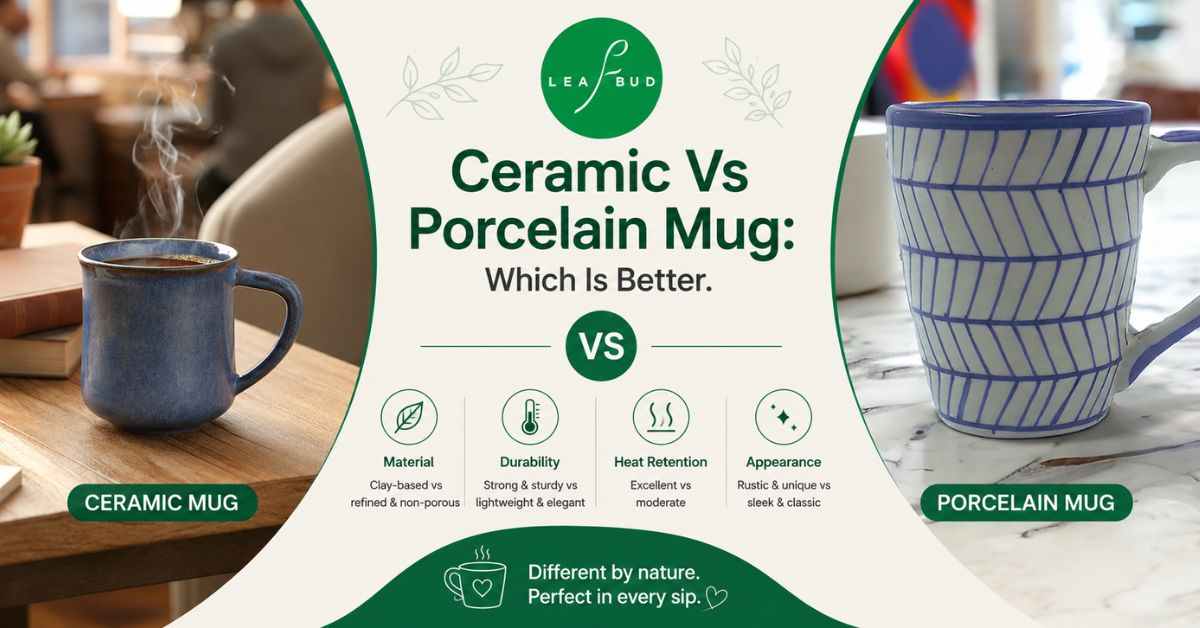
You grab a mug. It feels sturdy in your hands and retains heat well. It looks stylish on your shelf. What you (likely) don’t think about is if it’s ceramic or porcelain, and what that actually means for your morning beverage.
The ceramic vs porcelain mug debate is something you hear more often than you’d think. From kitchen table conversations to online shopping guides. They’re both made from clay. They’re both fired in a kiln. And they’re both great for making mugs! But they are not the same material. In fact, the differences between them are significant enough that it can affect your mug’s performance each morning.
Let’s break it down.
The Key Difference: What Are They Actually Made Of?
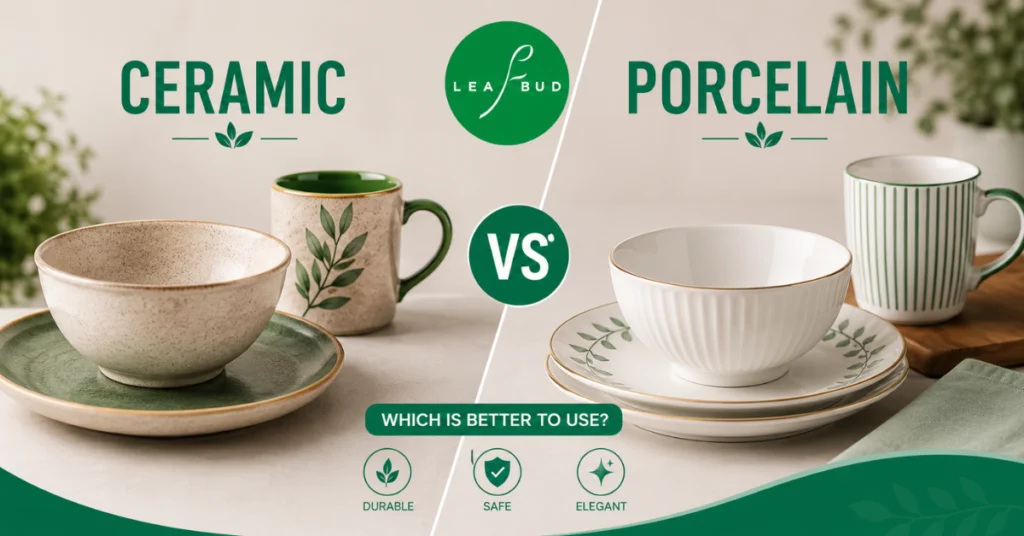
Okay, let’s start here. Porcelain isn’t its own material. It’s a type of ceramic. Ceramic is sort of like the family, and porcelain is a smaller subgroup within that family.
So when we say ceramic we’re talking about any clay item that’s molded then fired in a kiln. Earthenware, stoneware, and porcelain are all ceramics. The differences between porcelain and stoneware come down to the clay used and the temperature at which it’s fired.
Stoneware clay (what most ceramic mugs are made from) is made from natural pottery clay and mixed with minerals. It’s typically fired at temperatures ranging from 1,100°C to 1,300°C. The finished product is dense with texture and has more heft and warmth to it.
Porcelain is made from kaolin clay (a white clay) mixed with feldspar and quartz. It’s fired at higher temperatures than stoneware usually between 1,200°C and 1,450°C. Some porcelain, such as fine china, is fired up to 1,450°C. The high temp causes what’s called vitrification to happen, which is when the clay particles melt together creating a non-porous, almost glass-like surface.
It’s that small difference that gives the materials different looks and feels when you hold them.
Ceramic vs Porcelain Mug: A Direct Comparison
Let’s go category by category.
Heat Retention
Winner: Ceramic (stoneware)
Ceramic mugs win on heat retention, and it comes down to physics. Stoneware has thicker walls and greater thermal mass, meaning it absorbs more heat and releases it slowly. Pour a hot coffee into a stoneware mug and it stays warm longer.
Porcelain heats up quickly because its walls are thinner. That also means it cools down faster. If you drink slowly or get distracted mid-cup, a ceramic stoneware mug will serve you better.
That said, porcelain’s faster cooling can actually be a benefit for delicate teas that taste better at lower temperatures. Green tea and white tea, for example, should be brewed and drunk at lower temperatures than black coffee.
Durability and Chip Resistance
Winner: Porcelain (on paper), but the gap is smaller than you think
Porcelain is denser and harder because of its higher firing temperature and vitrification process. A fully vitrified porcelain body is technically more resistant to chips and scratches than earthenware or low-fire ceramic.
High-fired stoneware, on the other hand, performs extremely close to porcelain in everyday durability. According to the American Ceramic Society, ceramics fired above 1,200°C produce a significantly denser body that resists wear well. The risk with porcelain is its thinner walls. While the material itself is hard, a thin porcelain mug dropped on a hard floor is more likely to shatter than a thick stoneware one.
For daily kitchen use, a good quality stoneware mug handles drops and dishwashing cycles with fewer concerns about breakage.
Weight and Feel
Winner: Depends entirely on preference
This is one of the most noticeable real-world differences. Pick up a stoneware mug and it feels substantial. It has heft. Many people find that reassuring and comfortable, the feeling of a proper mug that could survive a clumsy morning.
Porcelain mugs are lighter and thinner. They feel delicate and refined. If you prefer that elegant, almost weightless quality when you hold your cup, porcelain wins. If you want something that feels grounded and solid, stoneware is your choice.
Flavour Neutrality
Winner: Porcelain (marginally)
Both ceramic stoneware and porcelain are chemically inert and do not react with your drink. Neither adds taste.
The difference appears in porosity. Stoneware without a fully intact glaze can slowly absorb traces of liquids over time, which may eventually affect flavour. This is called ghosting, and it is more common in older mugs with crazed or cracked glazes.
Porcelain’s fully vitrified, non-porous body does not absorb anything even if the glaze is slightly damaged. For tea enthusiasts who drink light or floral teas, this makes a genuine difference. For everyday coffee drinkers with well-glazed stoneware, the gap is negligible.
Design and Aesthetics
Winner: Ceramic (stoneware) for character; Porcelain for refinement
Here is where the two materials go in completely different directions aesthetically.
Porcelain has a pure white, smooth, almost translucent surface. Held up to light, high-quality porcelain lets light pass through. It has a formal, elegant look that suits clean, minimal design and fine dining settings. Patterns on porcelain tend to have a crisp, detailed quality.
Ceramic stoneware carries natural variation in colour, texture, and glaze behaviour. The earthy clay tones, the way reactive glazes pool and drip, the slight imperfections in a hand-thrown piece, these give stoneware a warmth and personality that porcelain cannot replicate. It looks handmade because it is.
For people who value artisan craft and individuality in their drinkware, stoneware wins. For those who prefer clean minimalism and a polished finish, porcelain is the natural fit.
Price
Winner: Ceramic (stoneware) for everyday budgets
Standard stoneware mugs cost less than equivalent porcelain ones, and the production reasons are straightforward. Stoneware uses more widely available clay and fires at lower temperatures, which reduces both material and energy costs.
Porcelain’s reliance on kaolin clay, combined with longer firing times at higher temperatures, pushes production costs up. The risk of pieces cracking or warping at extreme kiln temperatures also means a higher rejection rate during manufacturing, and those losses get factored into the price.
That said, a handcrafted artist stoneware mug can cost more than a basic mass-produced porcelain piece. Price reflects both material and craftsmanship, not material alone.
Side-by-Side Summary
| Feature | Ceramic (Stoneware) | Porcelain |
| Clay type | Natural pottery clay | Kaolin + feldspar + quartz |
| Firing temperature | 1,100°C–1,300°C | 1,200°C–1,450°C |
| Wall thickness | Thicker | Thinner |
| Weight | Heavier | Lighter |
| Heat retention | Higher | Moderate |
| Flavour neutrality | Good | Excellent |
| Porosity | Slightly porous (glaze-dependent) | Non-porous (vitrified) |
| Chip resistance | Good | High (but thinner walls) |
| Aesthetic | Earthy, textured, artisan | Smooth, white, refined |
| Typical price | Lower | Higher |
| Best for | Everyday use, coffee, artisan gifts | Formal settings, delicate teas |
Which Should You Actually Choose?
The honest answer: it depends on how you drink and what you value.
Choose a ceramic stoneware mug if:
- You drink coffee or black tea and want it to stay warm longer
- You prefer a mug that feels solid and grounded in your hand
- You appreciate handcrafted pieces with natural variation and character
- You want something made for daily use that handles dishwashers and countertop knocks
- You are looking for a gift that feels personal and artistic
Choose a porcelain mug if:
- You drink light or floral teas and want the purest flavour
- You prefer a lightweight, elegant feel
- You are buying for a formal dining setting or gift that leans refined
- You prioritise scratch and stain resistance
For most people’s everyday routines, a good quality stoneware ceramic mug does the job better than porcelain. It keeps drinks warmer, feels more comfortable in the hand during a long morning, and holds its own aesthetically on any table or shelf.

Why Handcrafted Stoneware Stands Apart
Handmade does not simply mean handmade design ware. While porcelain cups will certainly look pretty on your countertop, there is something missing in a machine pressed mug that comes straight from a factory.
Hand thrown stoneware however will have slight variations in the thickness of the walls as it is shaped by hand. The glaze application will also vary as it is brushed on by artisans affecting how it pools into the kiln. These little “imperfections” are what bring a piece to life.
Leafbud’s ceramic mug collection partners with local Indian ceramic artists to create hand thrown stoneware mugs in various glazes, shapes, and colour schemes. Each Artist Exclusive Edition mug is named after the artist who crafted the mug, which a ceramic factory mug from China can not claim. Checkout Leafbud’s collection of ceramic coffee mugs to see handmade stoneware in all its glory.
Care Tips for Both Types
Both mugs require similar basic care, with a few differences worth knowing.
For ceramic stoneware:
- Hand washing preserves the glaze longer, though most stoneware is dishwasher-safe
- Avoid drastic temperature changes to prevent thermal shock cracking
- Check the glaze periodically for crazing (hairline cracks) and replace mugs where the clay body is exposed
- Do not microwave mugs with metallic glaze accents
For porcelain:
- Porcelain is generally dishwasher-safe, but fine china should be hand washed
- Avoid banging porcelain mugs together during storage as the thinner walls chip at the rim more easily
- Porcelain handles thermal shock less well than thick stoneware due to thinner walls
- Do not microwave porcelain with metallic or gold trim
A Note on the Terminology Confusion
One reason people find this comparison confusing is how loosely the word “ceramic” gets used in marketing. Products labelled “ceramic mugs” almost always refer to stoneware. Products labelled “porcelain mugs” may sometimes actually be earthenware or low-quality stoneware with a white finish, marketed to sound more refined.
Here is a quick way to tell them apart in a shop:
- Hold the mug up to a light source. Thin porcelain will show some translucency. Stoneware will not.
- Check the weight. Stoneware feels noticeably heavier.
- Look at the base. Porcelain typically has a finer, smoother unglazed foot ring. Stoneware has a rougher, grainier texture at the base.
- Check the colour of the clay at the foot ring. Porcelain is white or off-white. Stoneware shows earthy grey, tan, or brown tones.
Frequently Asked Questions
What is the main difference between a ceramic and a porcelain mug?
The main difference lies in the clay and firing process. Porcelain uses refined kaolin clay fired at higher temperatures, producing a denser, thinner, non-porous body with a white finish. Ceramic stoneware uses natural pottery clay fired at somewhat lower temperatures, producing a thicker, heavier mug with earthy tones and natural texture. Both are food-safe and suitable for daily use.
Is a ceramic mug better than a porcelain mug for keeping coffee hot?
Yes, ceramic stoneware generally keeps coffee warmer for longer. Its thicker walls and greater thermal mass absorb more heat and release it slowly. Porcelain has thinner walls that heat and cool faster. For slow coffee drinkers, a stoneware mug is the better choice. For tea enthusiasts who prefer faster cooling, porcelain can actually be an advantage.
Are porcelain mugs more fragile than ceramic mugs?
Porcelain is a harder, denser material due to its high firing temperature, but its thinner walls make it more prone to shattering on impact compared to thick-walled stoneware. Stoneware mugs tend to chip at edges when dropped, while porcelain may break cleanly. For rough daily kitchen use, a well-made stoneware mug is generally the more practical option.
Can I use both ceramic and porcelain mugs in the microwave?
Most ceramic stoneware and porcelain mugs are microwave-safe, provided they have no metallic glaze accents or gold trim. Porcelain can sometimes cause uneven heating in the microwave due to its dense, vitrified body, which may make it uncomfortably hot to hold. Always check the manufacturer’s guidance before microwaving either type.
Which type of mug is better as a gift, ceramic or porcelain?
For a personal, artisan gift, handcrafted ceramic stoneware is usually the stronger choice. The natural variation in glaze and form makes each piece feel individual. Brands like Leafbud offer artist-made ceramic mugs that carry both craft and character. Porcelain is better suited as a formal gift for someone who prefers fine, minimalist drinkware.