Chat with us
FREE Leafbud Umbrella on Prepaid Orders Above INR 4,500/-
FREE Leafbud Umbrella on Prepaid Orders Above INR 4,500/-
FREE Leafbud Umbrella on Prepaid Orders Above INR 4,500/-
FREE Leafbud Umbrella on Prepaid Orders Above INR 4,500/-
FREE Leafbud Umbrella on Prepaid Orders Above INR 4,500/-
FREE Leafbud Umbrella on Prepaid Orders Above INR 4,500/-
FREE Leafbud Umbrella on Prepaid Orders Above INR 4,500/-
FREE Leafbud Umbrella on Prepaid Orders Above INR 4,500/-



Is Ceramic Mugs Better Than Glass Mug for Coffee?

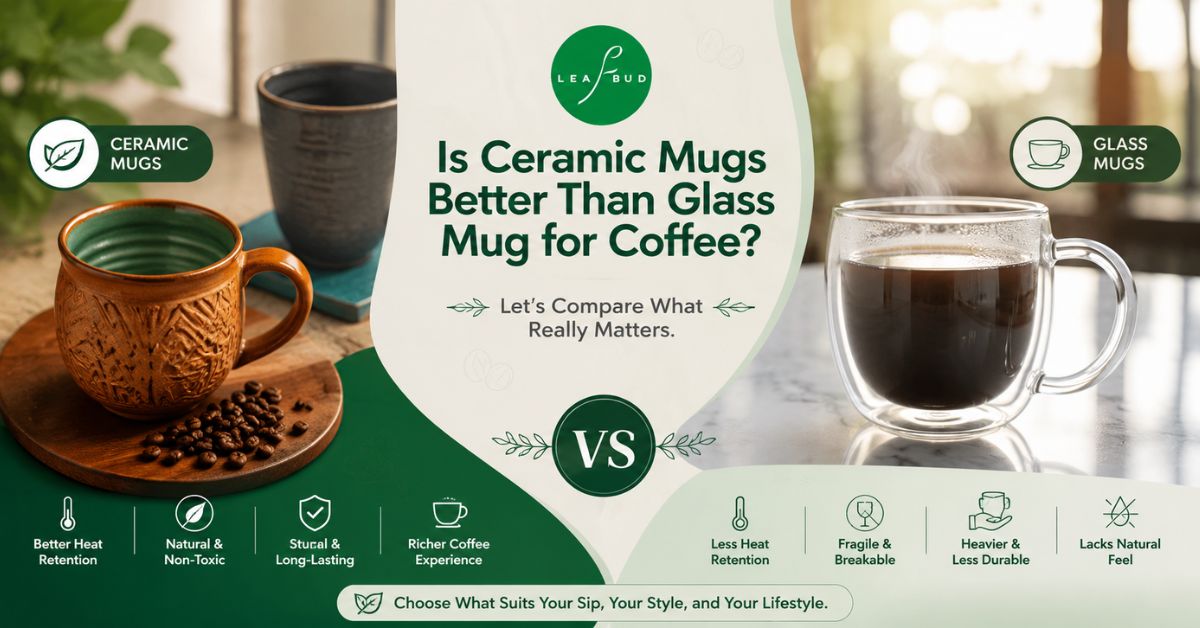
You brew your morning coffee, hold the mug with both hands, and take a sip. It’s not just what’s inside the mug that matters. It’s the mug itself. Coffee drinkers have been debating quietly for years: should you use ceramic mugs or glass mugs for coffee? For most casual coffee drinkers the answer is yes. Let’s explore why so you can choose for yourself.
How Mug Material Affects Your Coffee Experience
When buying a mug for yourself most individuals choose based on aesthetics. While that is certainly reason enough I am about to tell you about how material affects heat retention, flavor, and even comfort in your hand. For the sake of this comparison we will examine ceramic and glass.
Glass and ceramic are both non-reactive, so they will not leach chemicals or flavor into your beverage unless you play freak witch doctor with them. From there things begin to differ.
Heat Retention: Ceramic vs. Glass Mug for Coffee
This is why ceramic is better for most coffee drinkers.
Ceramic is porous. It’s made from clay that’s fired in a kiln. When clay is fired, little pockets of air are left behind in the ceramic material. Air doesn’t conduct heat very well, so this space makes ceramic a natural insulator. The difference in density between ceramic and glass is what causes this. Ceramic is porous and less dense than glass. Glass does not have these air pockets so heat will transfer through it more quickly.
To put it in scientific terms: Ceramic has a thermal conductivity of around 1.1 to 1.5 W/m·K, while stainless steel has a thermal conductivity of 14 to 16 W/m·K.
It’s a simple fact that ceramic has thicker denser walls than glass. This allows your coffee to retain heat longer than thin-walled glass mugs.
One caveat: there are always exceptions to every rule. Double-wall glass can have the same, if not better thermal retention than ceramic because of the air space created between the two walls of glass. If you are using a single wall glass mug and comparing it to an average ceramic mug then yes ceramic retains heat better. However if you’re using double-wall glass, it trumps ceramic every time
What About Wall Thickness?
Wall thickness is important as well. Thick-walled mugs are heavier which can be tiring, and for delicate, flavorful coffees served at very specific temperatures, too much insulation can cause your drink to stay out of its most flavorful temperature range for longer. Many specialty baristas will intentionally choose a thinner cup or even glass for pricey pour-overs so that the coffee reaches its optimal flavor range faster.
If you drink intricate, lightly roasted specialty coffee, a glass mug may actually be better for you as it allows the coffee to cool at a rate that optimizes flavor.
Flavor: Does the Mug Change How Coffee Tastes?
Here’s another tidbit for you to know. Ceramic doesn’t flavor your drink. There’s no metallic tang, no smell of plastic, and no feeling like your coffee or tea is being smothered. It’s why so many coffee and tea connoisseurs who value flavor choose ceramic.
Glass has this advantage as well. Chemically speaking, both glass and ceramics are inert, so neither will give your coffee bad flavors. The difference is what happens to your coffee once it sits.
Coffee in ceramic will stay hot longer, because ceramics insulate better than glass. And since coffee will begin to taste different as it cools down, the longer you can keep it hot, the longer you can enjoy the optimal flavor.
Now we come to the final sense: smell. There’s one aspect of aroma that most people don’t think about. Because ceramic retains heat well, it also better retains the volatile compounds that create your coffee’s aroma. And did you know that the shape of your mug can influence how your drink’s aroma travels to your nose? (A wider rim equals more aroma reaching you) Which means more aroma = more perceived flavor.
Comfort and Handling: Which Feels Better?
Pick up an ordinary ceramic mug filled with hot coffee. Now pick up a single-wall glass mug full of coffee. You’ll notice that the latter mug feels significantly warmer.
Why? Kaleena Teoh, co-founder of Coffee Project NY, told me she loves drinking out of ceramic mugs because they feel good to touch and there’s nothing quite like holding a warm cup of coffee. She added that ceramic mugs would likely also feel more comfortable to hold longer, since the material doesn’t heat up as much when you fill the cup with hot liquid, like metal or glass does.
That’s because there’s insulation between the inside and the outside of a ceramic mug. The exterior remains at a comfortable temperature even as the interior stays hot. Glass doesn’t provide that insulation.
Durability: Which Mug Lasts Longer?
Ok, let’s set the record straight. Both will break if dropped. But when it comes to everyday use…
Ceramic mugs are generally tougher for everyday use. They are much harder to break with impacts, scratches, and thermal shock. A well made ceramic mug can take hits that could cause glass mugs to crack or break.
Ceramic mugs resist chips and are great for indoor hospitality settings. But if they do hit the floor they can crack. Tempered glass mugs and borosilicate mugs are quite durable, but can still crack upon impact.
Borosilicate glass is a bit of a special case. Borosilicate glass can take on heat changes much easier than regular glass. It also doesn’t crack as easily from heat. If you’re set on glass go with borosilicate glass, even though they are more expensive.
Ceramic mugs come out on top for durability when it comes to normal everyday use at home. They can handle bumps and bangs that would shatter glass.
Aesthetics: Glass Has a Clear Advantage (Literally)
This is where glass really shines. You can actually see your espresso bloom, or watch the oat milk swirl in your latte, or just appreciate the color of your cold brew. Ceramic doesn’t allow you to appreciate your coffee visually like glass does.
One major benefit of glass mugs is being able to see the color and layering of your coffee.
Where ceramic excels, is in its unique beauty. When you drink out of a handmade ceramic mug there is texture, glaze variations, and color that will differ from mug to mug. Every ceramic mug at Leafbud is hand molded by one of our artisans. So the mug you purchase from us is 100% one of a kind.
Environmental Considerations
Choosing between ceramic and glass from an environmental perspective isn’t cut-and-dry. Ceramic is lighter than glass, and therefore cheaper to ship in terms of energy used. One glass mug may not be that much heavier than one ceramic mug, but even half of an ounce matters when you’re shipping hundreds or thousands of mugs. Glass made with locally-recycled material will have a much lower footprint in terms of production. Shipping weighs in favor of ceramic. Both will outlive single-use cups by decades. If you have to pick one, either will serve you far better than paper or plastic.
When to Choose Ceramic: A Quick Reference
Ceramic mugs make the most sense when you want to:
- Keep your coffee hot for a longer stretch at home or at your desk
- Hold a mug comfortably without burning your hands
- Use a microwave-safe vessel for reheating
- Own something durable enough for daily use over years
- Appreciate handcrafted art in a functional form
When a Glass Mug Works Better
Glass mugs are worth considering when you want to:
- Watch the visual layers in a latte, cappuccino, or layered cold brew
- Drink expensive specialty pour-overs that taste best as they cool
- Serve guests in a modern, minimalist setting
- Use a double-wall glass that matches ceramic’s insulating performance
Handcrafted Ceramic Mugs: Why Artisan Quality Matters
Not all ceramic mugs are the same. Mass-produced ceramic can be inconsistent in wall thickness, glaze coverage, and firing temperature. These factors directly affect how well the mug performs.
Handcrafted ceramic mugs feel intentional, thoughtful, and often soulful. Unlike mass-produced metal or glass, they come with character, texture, and artistry. Commercial-grade handmade ceramics are also built to last, and when crafted by skilled artisans, they are lead-free, food-safe, and made with eco-conscious practices.
This is why Leafbud focuses on artisan-made ceramic mugs. Each piece comes from a skilled potter, with glazes applied by hand and shapes thrown with care. The result is a mug that performs well and looks genuinely beautiful on your table.
Ceramic Mugs Better Than Glass Mugs for Coffee: The Verdict
For the average home coffee drinker, ceramic mugs are the better choice. They keep coffee warmer longer than standard glass, stay comfortable in the hand, hold up to daily use, and carry a character that mass-produced glassware rarely achieves.
Glass has real strengths, especially double-wall glass and for specialty coffee that benefits from gradual cooling. But as a general-purpose coffee mug, ceramic covers more ground.
At Leafbud, the handcrafted ceramic mugs bring both performance and personality to your morning ritual. Whether you pick up a mug with a matte earth glaze or a bold hand-painted finish, you get a piece made by someone who cares about the work.
Frequently Asked Questions
1. Are ceramic mugs better than glass mugs for keeping coffee hot?
Yes, in most standard comparisons. Ceramic’s fired-clay structure contains tiny air pockets that slow heat transfer. This keeps your coffee warmer for longer than a single-wall glass mug. Double-wall glass mugs are the main exception, as the air gap between walls makes them comparable in performance.
2. Does the type of mug change the taste of coffee?
Both ceramic and glass are non-reactive, so neither adds flavors to your coffee. The difference is indirect. Ceramic keeps coffee hotter longer, and since coffee flavor changes as it cools, drinking from a ceramic mug means you spend more time in the optimal flavor window before your brew goes flat.
3. Is a ceramic mug safer than a glass mug for hot drinks?
From a chemical safety standpoint, both are safe when food-grade materials are used. From a handling standpoint, ceramic stays cooler on the outside, which makes it easier and safer to hold. High-quality ceramic mugs like those from Leafbud are lead-free and food-safe by design.
4. Which is more durable for everyday use: ceramic or glass?
Ceramic generally wins for everyday durability. It resists chips, scratches, and minor impacts better than standard glass. Borosilicate glass is stronger than regular glass and handles thermal shock well, but a good ceramic mug still tends to outlast standard glassware when used daily.
5. Can I use a ceramic mug in the microwave?
Most glazed ceramic mugs are microwave-safe, as long as they do not have metallic accents in the glaze. Glass mugs are also generally microwave-safe. Always check the care instructions for your specific mug, especially for handcrafted pieces with specialty glazes, to make sure there are no restrictions.