Chat with us
FREE Leafbud Umbrella on Prepaid Orders Above INR 4,500/-
FREE Leafbud Umbrella on Prepaid Orders Above INR 4,500/-
FREE Leafbud Umbrella on Prepaid Orders Above INR 4,500/-
FREE Leafbud Umbrella on Prepaid Orders Above INR 4,500/-
FREE Leafbud Umbrella on Prepaid Orders Above INR 4,500/-
FREE Leafbud Umbrella on Prepaid Orders Above INR 4,500/-
FREE Leafbud Umbrella on Prepaid Orders Above INR 4,500/-
FREE Leafbud Umbrella on Prepaid Orders Above INR 4,500/-



Are Ceramic Bowls Non Biodegradable?

You just broke your favourite ceramic bowl on the kitchen floor. As you start to sweep up the pieces, a question pops into your head: Does this stuff ever break down in the soil, or will it just sit in a landfill for hundreds of years? Let us do a proper breakdown with real science and no guesswork.
The Short Answer: Yes, Ceramic Bowls Are Non-biodegradable
Ceramic bowls are non-biodegradable once fired in a kiln. That’s the naked fact. Microorganisms can digest a banana peel or a cotton cloth but not fire clay. According to research summarised by the National Institutes of Health, biodegradation is “the process by which microbes break a material down into carbon dioxide, water, and biomass.” Fired ceramics will not qualify. When clay is fired beyond a certain point, it becomes an entirely different kind of structure, an inorganic, glassy substance.
So when you ask, “Are ceramic bowls non-biodegradable?”, the truthful answer is yes. But that doesn’t tell the whole story and doesn’t mean ceramic is automatically a bad choice for your kitchen. You just hold on to this post, and you’ll see.
What ‘Biodegradable’ Really Means (And Why Ceramic Doesn’t Qualify)
People love to throw around the word “biodegradable” with little thought of what it really means. You can test it easily.
Just do this:
- Biodegradable materials are those that are decomposed by microbial action into water, CO₂, and organic matter in a reasonable time.
- Compostable materials require engineered conditions to break down, including controlled heat, moisture, and oxygen.
- Non-biodegradable materials are not decomposed by microbial action and remain in their original form for very long periods, sometimes for centuries.
Ceramics are inorganic materials made by heating minerals such as clay, feldspar, and quartz to high temperatures. Their chemical and physical structure gives them resistance to heat, corrosion, and wear. So once fired, a piece of ceramic may take hundreds to thousands of years to break down in nature, and even then, it’s through weathering and erosion, not microbes eating it away. That is an entirely different road than how a paper plate or banana peel goes away.
Why Fired Clay Behaves This Way
Raw clay, before it ever gets to a kiln, is another story. Wet, unfired clay can be soaked in water and re-formed, and it is very close to its natural mineral form. But when a potter puts that same clay in a kiln at extreme heat, it all changes.
The bodies of ceramic tableware are usually fired at about 2,200 to 2,450 degrees F, and many ceramic materials melt at temperatures close to 3,600 degrees F. At that temperature, the clay particles melt together and form a hard, glassy structure. This is called vitrification, and this is what makes ceramic bowls strong, smooth, and able to last for decades of daily use on your dining table. That’s also exactly why the finished bowl will not rot, dissolve, or be food for bacteria like an organic material would.
Does “Non-Biodegradable” Mean Ceramic Is Bad for the Planet?
Not really, and that’s why it matters. A material’s environmental footprint is a lot more than whether it can be eaten by soil microbes.
There are qualities of ceramic that work in its favour:
- It is made from abundant natural minerals like clay, feldspar, and silica, not petroleum.
- It won’t leach microplastics into your food or into the waterways like plastic bowls can over time.
- When fired, it is inert and non-toxic, so it will not give off harmful particles in normal use.
- It lasts for years, sometimes generations, so you’re not replacing it every couple of months like you would with cheap plasticware.
- It is fully recyclable and can be crushed and reused in new ceramic bodies, road base material, or construction aggregate.
Compare that to single-use plastic bowls. Plastic sheds microplastics, sits in landfills for hundreds of years, and rarely gets a second life. A reusable ceramic bowl, while it won’t compost in your backyard, often has a smaller real-world footprint because you keep using the same piece for years instead of throwing away a new one every week.
Ceramic vs Plastic vs Bamboo: A Quick Comparison
| Material | Biodegradable? | Typical Lifespan | Microplastic Risk |
| Fired ceramic | No | Years to decades with normal use | None |
| Single-use plastic | No | Weeks (but stays in landfill for centuries) | High |
| Bamboo/plant fibre | Often yes, under the right conditions | Months to a few years | Low |
| Unfired clay | Yes | Breaks down quickly if wet | None |
This table makes one thing clear: “non-biodegradable” and “environmentally harmful” are not synonyms. A reusable bowl that lasts for ten years is better than a technically compostable one that you will throw away after one meal.
How to Dispose of a Broken Ceramic Bowl the Right Way
Cracked a bowl beyond repair? Chipped a mug? So, here’s how to deal with it without just throwing it in your normal kitchen bin.
- Wrap the broken pieces in a rag or newspaper and throw them away. Broken ceramic has sharp edges that can hurt waste handlers.
- Find a local recycling option. Some cities take broken ceramic as a construction and demolition material. Ceramic is one of the material categories under India’s Environment (Construction and Demolition) Waste Management Rules, along with soil, bricks, concrete, and wood, and it is expected that larger construction sites will send this waste to registered processing facilities, not to open landfills.
- Use the pieces at home. Broken bowl pieces are great for drainage at the bottom of flower pots, mosaic tile bits for garden art, or an edge for flower beds.
- Please do not discard unused pieces; donate them whole. They may be in demand in another person’s kitchen.
Ceramic waste is classified as “inert”, which sounds mean but in fact is not polluting soil and water like chemical waste. It’s just taking up physical space, so reusing or recycling keeps it out of the general landfill and is the smarter move.
Choosing Ceramic Bowls That Last Longer
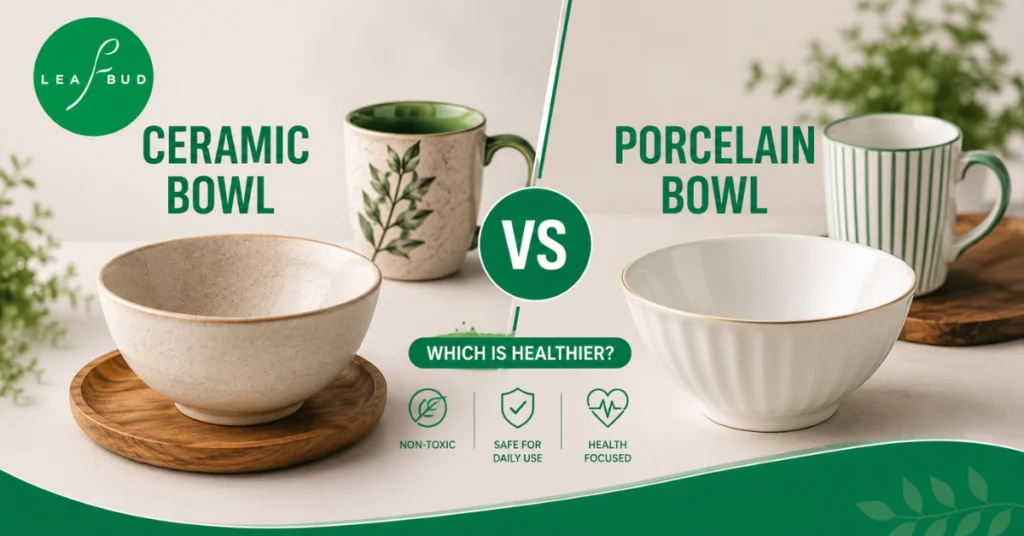
If a bowl is going to be around for decades, then it’s worth getting one that’s been made with care, rather than churned out in bulk. Hand-thrown pottery that is fired and glazed properly with food-safe glazes is more likely to hold up over time against chipping and crazing. That’s where a brand like Leafbud comes into the picture. Leafbud partners with artisans to create hand-crafted ceramic serveware, bowls, plates, and tableware that’s meant for everyday use, not a one-season wonder. The most practical answer to biodegradability is ironically to choose pieces that are made to last. If a bowl sits in your kitchen for fifteen years instead of being thrown out after fifteen months, its actual environmental impact goes way down, compost or not.
When shopping for serveware, don’t just look for the label that says it’s biodegradable. Ask yourself: will this piece hold up to daily use, and will I want to keep it around for years? Leafbud’s ceramic bowls and other serveware pieces are designed for exactly that kind of longevity, which is more relevant in practice than a technical soil-breakdown timeline.
Wrapping Up
Once-fired ceramic bowls are non-biodegradable, and no amount of time in your garden compost bin will change that. But that one fact alone cannot tell the whole sustainability story. A good ceramic bowl is non-toxic, free of microplastics, recyclable at the end of its life, and built to last much longer than most alternatives on the market. Dispose of broken pieces responsibly and buy well-made pieces, and you will get the best of what ceramics has to offer.
FAQs
Are ceramic bowls biodegradable or compostable?
No. Once fired, ceramic bowls are neither compostable nor biodegradable. The firing process converts the clay into a hard, glass-like substance that microbes cannot digest. Raw, unfired clay can rot, but the bowl on your table cannot.
Is ceramic worse for the environment than plastic?
Not usually. Unlike plastic bowls, which degrade quickly and end up in landfills, ceramic bowls do not release microplastics and can last for years with normal use. Reusable, durable ceramic typically has a smaller footprint over its entire life.
Can broken ceramic bowls be recycled?
Yes, in lots of places. Crushed ceramic is used as aggregate in construction, as road base, or for new ceramic products. Not every city has a dedicated stream for recycling ceramics yet, so check with your local waste management authority.
How long does a ceramic bowl take to break down in nature?
Ceramics, when fired, can take hundreds to thousands of years to break down by natural weathering alone, not by microbial action. In practical terms, assume it’s permanent unless it is recycled or reused.
Is it safe to throw broken ceramic bowls in the regular trash?
First, wrap the pieces so the waste handlers aren’t cut by sharp edges. If there is a construction and demolition waste facility or a ceramic recycling point, use it instead of the general bin.
Shop Handcrafted Ceramic Bowls