FREE Leafbud Umbrella on Prepaid Orders Above INR 4,500/-
FREE Leafbud Umbrella on Prepaid Orders Above INR 4,500/-
FREE Leafbud Umbrella on Prepaid Orders Above INR 4,500/-
FREE Leafbud Umbrella on Prepaid Orders Above INR 4,500/-
FREE Leafbud Umbrella on Prepaid Orders Above INR 4,500/-
FREE Leafbud Umbrella on Prepaid Orders Above INR 4,500/-
FREE Leafbud Umbrella on Prepaid Orders Above INR 4,500/-
FREE Leafbud Umbrella on Prepaid Orders Above INR 4,500/-



Diya Decoration Ideas for Diwali: 12 Ways to Decorate and Arrange Diyas at Home

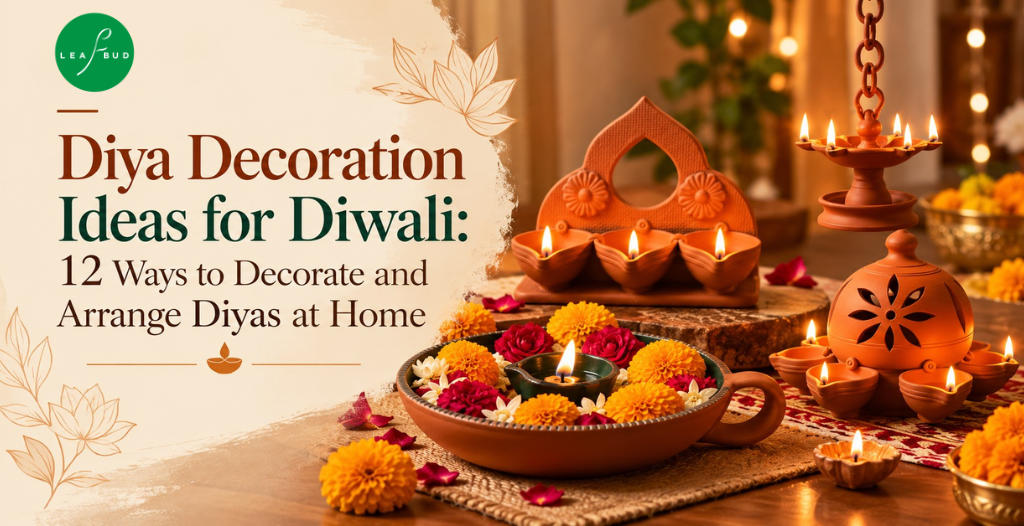
A row of diyas is the one Diwali decoration every home shares, whether it is a bungalow or a one-room flat. And because a plain clay diya costs a few rupees, it is also the easiest place to get creative.
This guide has two parts. The first four ideas are about decorating the diyas themselves. The other eight are about where and how to arrange them, which makes just as much difference to how your home looks on Diwali night. Diwali falls on Sunday, 8 November this year, so there is still time to try a few. If you are looking for diyas to buy, jump to our handmade picks.
The quick list
- Paint your diyas with acrylic colours
- Add mirrors, kundan and stones
- Paint traditional Madhubani or Warli motifs
- Give plain diyas a metallic rim
- Build a rangoli around your diyas
- Float diyas and flowers in a wide bowl
- Line the entrance and threshold
- Light up the staircase
- Make the balcony and windows glow
- Arrange diyas around the puja corner
- Create a centrepiece for the table
- Mix diyas with tealight holders indoors
Before you start: a few basics
Clay or handmade? Plain unglazed clay diyas are traditional and cheap, and they are the ones to paint. Handmade decorative diyas and holders cost more, but you buy them once and bring them out every Diwali.
Soak clay diyas first. If you are using plain clay diyas, soak them in water for a few hours and let them dry before lighting. Dry clay absorbs a lot of oil, and soaking means more of it goes to the flame. If you plan to paint them, soak and dry them before you start.
Keep the inside bare. Whatever you decorate, leave the inner bowl and the area around the wick unpainted. Paint, glue and stones near the flame can scorch, smoke or come loose.
Handmade diyas from Leafbud
If you would rather start with a few pieces you can use year after year, these handmade diyas and tealight holders work with the ideas in this guide. Every piece is handmade, so colour and finish vary slightly. Prices are MRP at the time of writing.
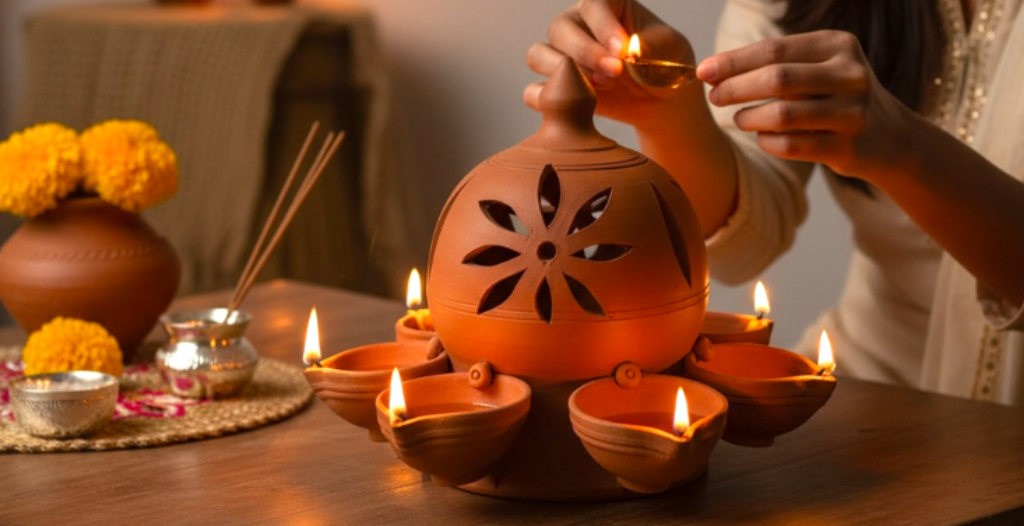
A circular diya holder that casts light in every direction, for a halo-like glow. At 8 inches across, it holds its own as the centrepiece of a puja shelf or a table.
Best for: the puja corner or a table centrepiece.
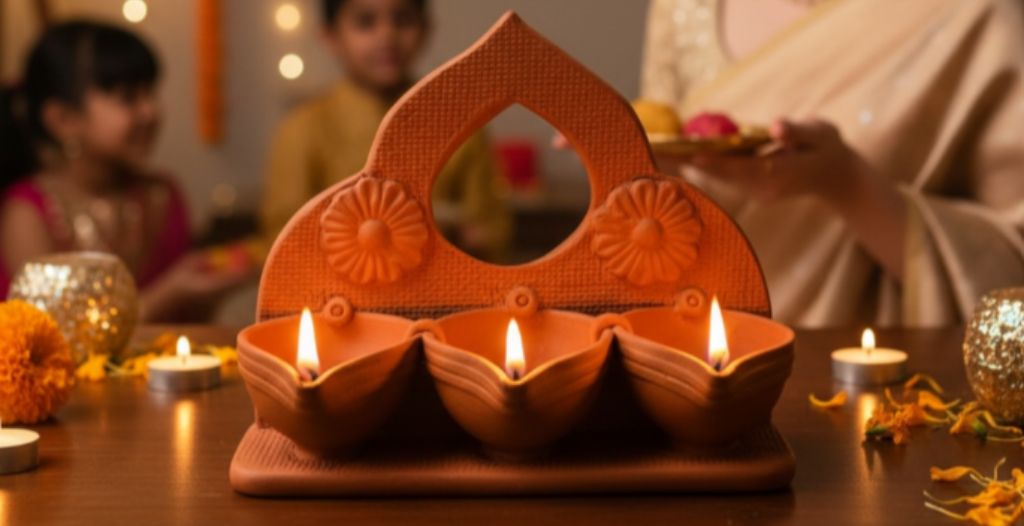
A beautifully crafted terracotta diya holder featuring three traditional oil lamps in a decorative stand with an elegant arched handle. Place it on a table, console, or near the main entrance to create a warm, festive glow.
Best for: Main door entrance, console tables, and festive floor or tabletop arrangements.
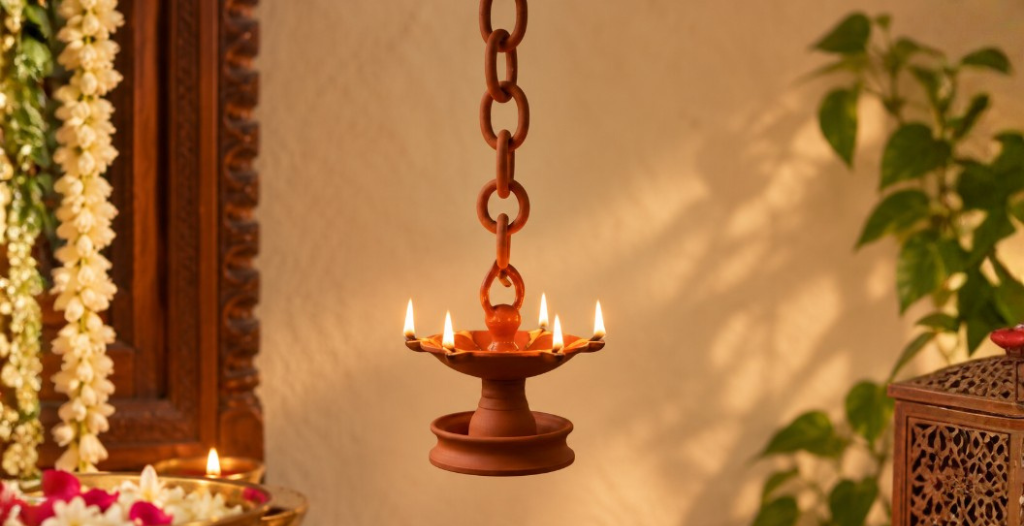
A 360-degree hanging diya on a handcrafted terracotta chain, about 20 inches long including the chain. Made for entryways, balconies and puja corners. Comes in brown and green and brown.
Best for: balconies and entryways
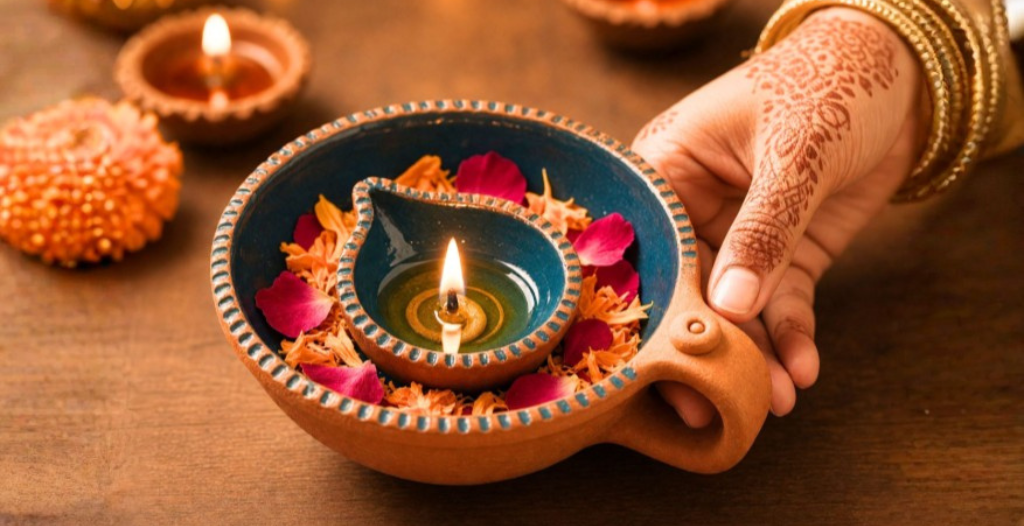
A beautifully handcrafted terracotta diya featuring a decorative blue inner bowl, intricate detailing, and a convenient side handle. Place it at your main entrance, in your puja room, or on a decorative table to add a vibrant and elegant touch to your Diwali décor.
Best for: Puja room decorations, main entrance, festive table arrangements, and traditional Diwali celebrations.
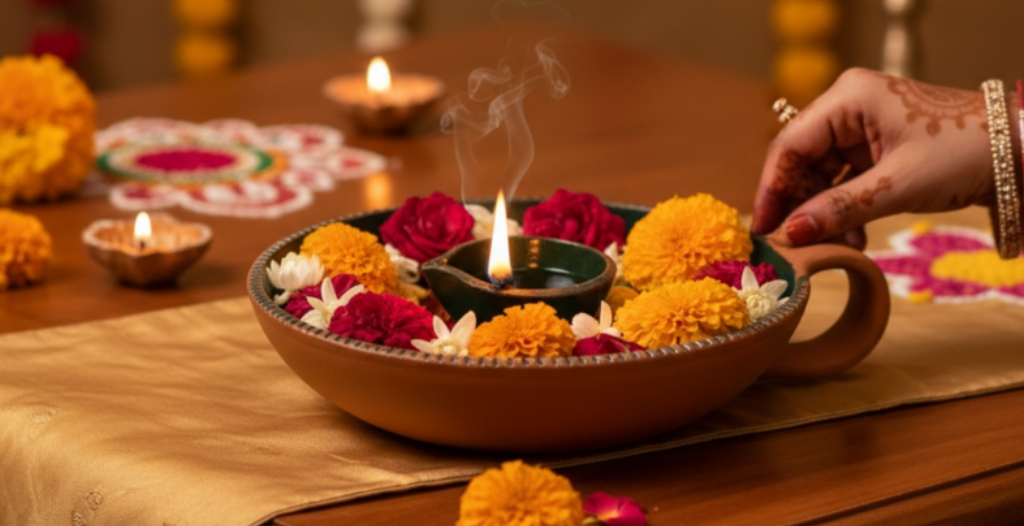
A beautifully handcrafted terracotta diya bowl featuring a central oil lamp, a convenient side handle, and an elegant earthy finish.
Best for: Main entrance decoration, centre tables, puja room décor, and festive floral arrangements.
You will find more in Lamps, Candles and the Festive Gifting collection. Any of these also makes a thoughtful gift when visiting family over Diwali.
Part 1: Decorating the diyas
1. Paint your diyas with acrylic colours
Acrylic paint is the easiest choice. It is easy to find, dries quickly and sticks well to clay.
Start with a white base coat on the outside of each diya, so your colours look bright rather than muddy against the terracotta. Once it has dried, add your main colour, then details: dots around the rim with the back of a brush, simple petals, or stripes. Two or three colours look more finished than six.
Let painted diyas dry for a full day before lighting them.
2. Add mirrors, kundan and stones
Small mirrors, kundan stones and sequins catch the flame beautifully once the diya is lit. Stick them on the outer wall of the diya, not the rim, using a strong craft glue.
Avoid placing anything right next to where the wick sits. A band of stones around the middle of the diya catches the light without getting too close to the heat.
3. Paint traditional Madhubani or Warli motifs
If you want diyas that look handcrafted rather than store-bought, borrow from Indian folk art. Warli figures in white paint look striking against plain terracotta, and you only need a fine brush and a steady hand. Madhubani-style fish, peacocks and borders work well on larger diyas, where there is room for detail.
These also make lovely gifts. A set of six hand-painted diyas in a box is a personal present for family you are visiting.
4. Give plain diyas a metallic rim
The quickest upgrade of all. Run a gold or copper metallic acrylic around the outer edge of each diya, and nothing else. It takes about a minute per diya and makes a tray of plain clay diyas look festive straight away.
Part 2: Arranging the diyas
5. Build a rangoli around your diyas
Diyas and rangoli belong together. Place diyas at the points of your design, around the outer border, or in a ring at the centre.
One practical tip: stand each diya on a small steel plate or saucer before placing it on the rangoli. Oil drips and stains the floor, and it smudges the colours.
6. Float diyas and flowers in a wide bowl
A shallow bowl of water with floating flowers and lights is one of the prettiest Diwali arrangements, and one of the safest, since every flame sits over water.
Fill a wide bowl or urli two-thirds with water. Scatter marigold and rose petals, then add floating candles, or diyas made to float. If you do not have an urli, any wide, shallow serving bowl works. A large ceramic bowl like the Leafbud Aurora Borealis Serving Bowl (L) makes a striking centrepiece for a coffee table or an entrance console.
7. Line the entrance and threshold
The main door is where diyas traditionally go first, to welcome Lakshmi and guests alike. Place a row on either side of the doorstep, or in a neat arc along the threshold.
For a little height, hang diyas at the doorway as well, with a hanger like the GlowDrop Trio Diyas. Keep a clear gap between any flame and the space people walk through, especially where sarees and dupattas brush past.
8. Light up the staircase
A diya on every step is one of the simplest ways to make the whole house feel festive. Place each diya at the wall side of the step, away from where people put their feet.
If the stairs are busy with family coming and going, use every second step, or switch to tealights in holders, which are much harder to knock over.
9. Make the balcony and windows glow
From the street, a balcony lined with diyas is what makes a home look lit for Diwali. The trouble is wind, which puts out an open flame within minutes.
Place diyas in the sheltered corners of the balcony, or use holders and glass covers that shield the flame. A hanging diya such as the SkyFlame Orb Diya is another good option.
For windows, line diyas along the inside sill, behind the glass, where the wind cannot reach them.
10. Arrange diyas around the puja corner
The puja corner is where diyas matter most. Arrange them evenly on either side of the mandir, or in a circle in front of it, and keep the main diya for the aarti in the centre.
A decorated puja thali with a diya, flowers, kumkum and rice is both part of the ritual and a decoration in itself. For a single piece that lights the whole corner, the Radiant Halo Diya suits an altar or puja shelf.
11. Create a centrepiece for the table
For the dining table or the coffee table, group diyas of different heights in the centre, with marigolds in a vase beside them. Keep them on a tray or a large platter, so any spilled oil stays off the table.
Odd numbers, such as three, five or seven, tend to look more natural than even rows. On the dining table, keep the arrangement low enough that people can see each other across it.
12. Mix diyas with tealight holders indoors
Inside the house, where there are curtains, cushions, children and pets, open diyas are not always practical. Tealight holders and lanterns give the same warm glow and are easier to keep an eye on.
A few holders like the Bloomlight Holder or the Radiant Glow Diffuser in the living room, with diyas kept to the safer spots, and the room still feels like Diwali.
Light them safely
A home full of open flames needs a few simple habits to stay safe.
- Never leave diyas burning in an empty room, and put them all out before you sleep.
- Keep flames well away from curtains, cushions and paper decorations, including dry marigold garlands and paper lanterns hung above them.
- Watch for clothing. Sarees, dupattas and kurtas brush past diyas easily in doorways and on staircases, so keep those spots clear.
- Fill diyas only half to two-thirds with oil, so they do not spill when knocked.
- Stand every diya on a plate or saucer, never directly on wood, fabric or a rangoli.
- Keep a bucket of water or sand nearby, especially near the entrance and balcony.
- Place diyas above the reach of small children and pets, or switch to tealight holders in the rooms they use.
After Diwali
Wash glazed ceramic diyas and holders in warm, soapy water once they have cooled, and they are ready for next year. Wipe the oil out of clay diyas with newspaper. Wrap each one separately before storing, since painted and decorated diyas chip easily when stacked.
Frequently asked questions
How can I decorate diyas at home for Diwali?
Paint the outside with acrylic colours over a white base coat, add mirrors, kundan or stones to the outer wall, or paint Warli or Madhubani motifs. For a quick finish, a metallic rim on plain clay diyas works well. Keep the inside of the diya bare and let paint dry for a full day before lighting.
Which paint is best for decorating diyas?
Acrylic paint is the most practical choice. It sticks well to clay, dries quickly and comes in metallic shades for gold and copper rims. Apply a white base coat first so the colours look bright, and do not paint the inner bowl where the oil and wick sit.
How do you make floating diyas?
Fill a wide, shallow bowl or urli two-thirds with water, scatter flower petals over the surface, and add floating candles or diyas made to float. Place the bowl on a stable surface, away from curtains.
Where should diyas be placed on Diwali?
Most homes light diyas at the main entrance, in the puja corner, on windowsills and balconies, and often near the tulsi plant and in the kitchen. The exact places and the number of diyas vary by family and region.
Which oil is best for diyas?
Mustard oil and sesame oil are the most common choices, and many families use ghee for the puja diya. Traditions vary, so follow what your family does. Fill each diya only half to two-thirds full to avoid spills.
Why should clay diyas be soaked in water before lighting?
Unglazed clay absorbs oil. Soaking diyas in water for a few hours and letting them dry means the clay takes up less oil, so the diya burns longer. Glazed ceramic diyas do not need soaking.
How do I stop diyas from going out on the balcony?
Place them in sheltered corners, use holders or glass covers that shield the flame, or use hanging diyas. Indoors, windowsill diyas placed behind the glass stay lit much longer.